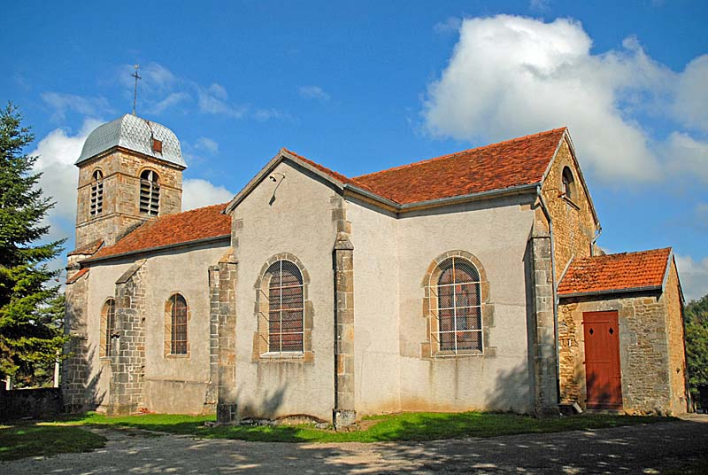
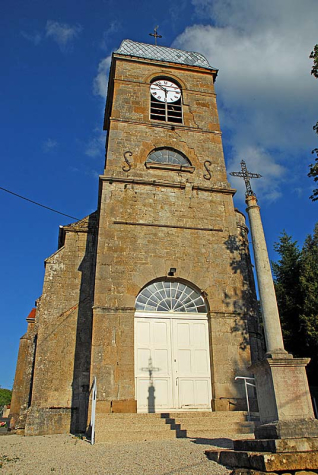
Once on the summit platform, you can walk around the choir of the church to reach the main entrance, after admiring the charming presbytery to the north, which is now privately owned.
The donation made by Canon Albéric in the 12th century was confirmed in 1170 by Pope Alexander III, who added the church and the tithes. We are therefore certain that a church dedicated to Saint Didier already existed at this date.
The oldest church we can guess from the current building is a 14th-century church visible in the first bay of the nave, with its characteristic vaulted ceiling and its flowery, anthropomorphic arches that were destroyed by the revolutionaries. This church also included the second bay, where the vaulting was destroyed in the 19th century (you can still see the ends of the vaulting identical to the first) and must have been extended by a narrower nave with a flat chevet, which disappeared completely under the 19th-century church. Outside on the north side, traces of the roof slope from this period at mid-height on the first buttress of the nave (which has since been raised), show that this early 14th century church was preceded by a low porch, which has now disappeared, housing the beginning of the arcature of the former entrance portal. After the Hundred Years' War, work was carried out to consolidate the building, which according to tradition had been partly burnt down, as a result of the observation of the external buttresses in the second bay, which are set at an angle and therefore not much earlier than the beginning of the 16th century.
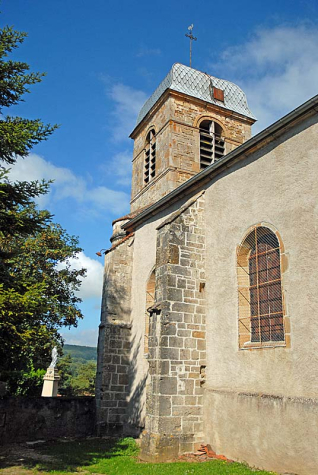
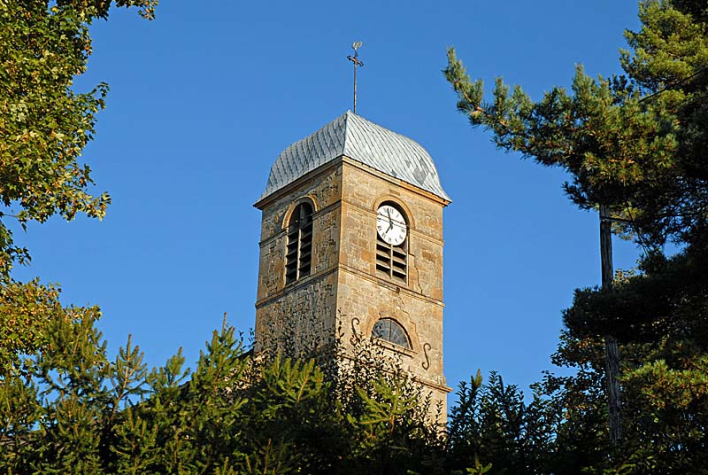
After the Revolution, the church was in a poor state of repair, and the sharp increase in population meant that it was time to carry out major works. Following two architects' projects in 1830 and 1831 at the request of the municipality, the architect Santa de Langres drew up an estimate for the extension of the church on 15 January 1834. The church was entirely rebuilt as we see it today, with a monumental choir preceded by a modest transept and a cross-vaulted nave, joining the first two bays of the early 14th-century nave. In addition, a monumental porch tower used as a bell tower (not included in the initial estimate) was built in front of the first bay of the nave. The work, carried out by Jean Roblet "building contractor in Langres", was completed on 28 November 1836.
However, in the autumn of 1845, the mayor denounced "the alarming state of the church, and in particular the bell tower", which was cracking by the day, and commissioned an expert report from the Langres architect Gaulet, who noted major defects in the reconstruction work carried out on the church in 1834-1836, and in particular the lack of adequate foundations for the bell tower, which was built on highly unstable clay soil. Faced with the threat of legal action, the architect and contractor reached a compromise, agreeing to pay two-thirds of the cost of the repairs, with the remaining third to be paid by the commune. However, these repairs were deemed insufficient, as the entire church would have to be rebuilt.
Discussions lasted almost forty years, before the poor commune of Charmes found a satisfactory solution through the architect Ravier from Lange. Ravier finally proposed, at a lower cost, to consolidate and reinforce the bell tower with double steel strapping on either side of the bells, and to insulate the bells from the masonry by separating the bells from the sheep using "Eguillon insulators" on the existing windchests, a system that had already proved its worth on several national historic monuments. The work was awarded in January 1891 to the contractor M.A. Mammès from Saints-Geosmes, who was responsible for anchoring, strapping and consolidating the bell tower with 195 kg of old iron, as well as repairing the cracks in the façade and carrying out some repairs to the roof. It is this temporary consolidation that is still in place today.
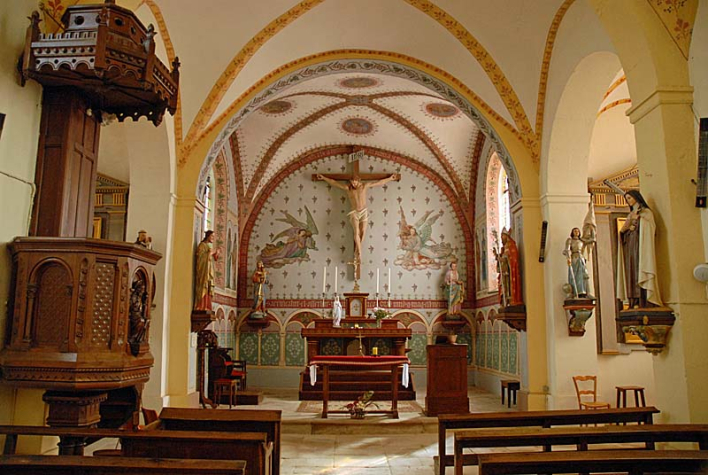
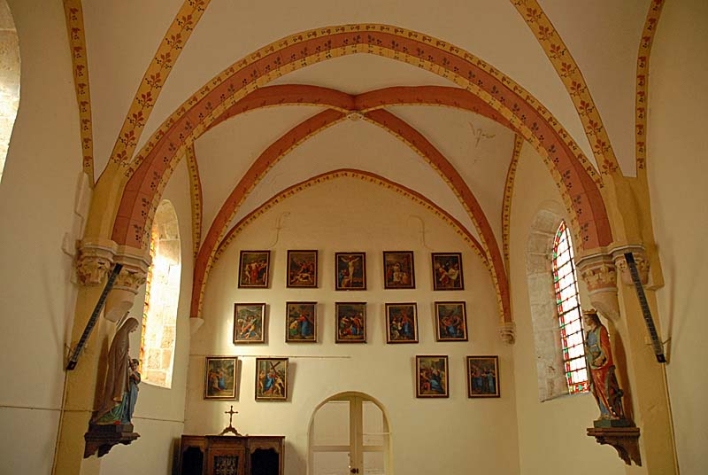
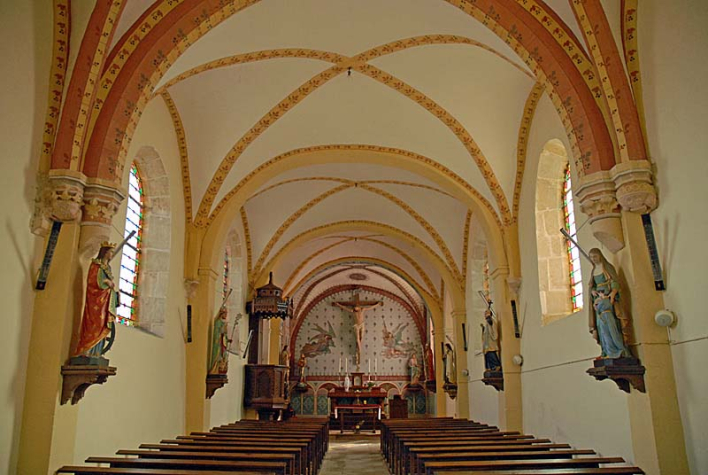
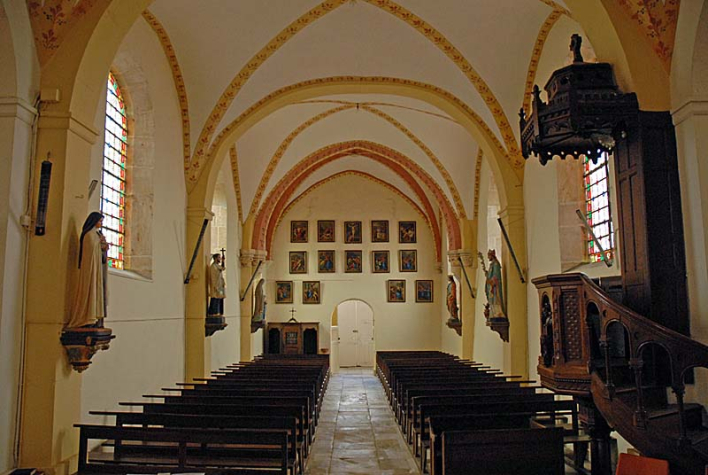
Inside, the restoration work carried out by the town council on the nave in 2003 and 2005, as well as the restoration of the sanctuary's wall paintings and its rich furnishings in 2010, has resulted in a very attractive church that is well worth a visit. The south transept features two 17th-century paintings of the Virgin Mary and St John the Baptist. These paintings are surmounted by a monumental 16th-century reliquary bust of Saint Didier, facing an 18th-century painting of Saint Didier standing in front of the town of Langres, just outside the gate of the same name. In the north transept, there are also two paintings from the same period, including a beautifully crafted Virgin and Child and, opposite, a representation of the Sacred Heart. Above the entrance porch are the fourteen paintings of the Stations of the Cross, dating from the late 19th century. Most of the restored furnishings are listed in the supplementary inventory of historic monuments.
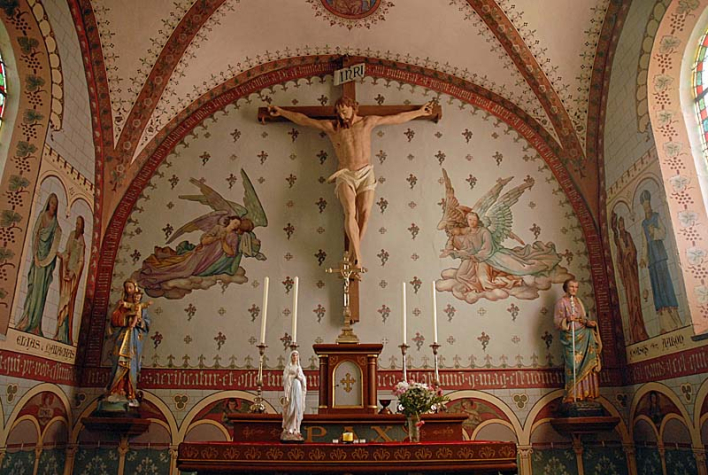
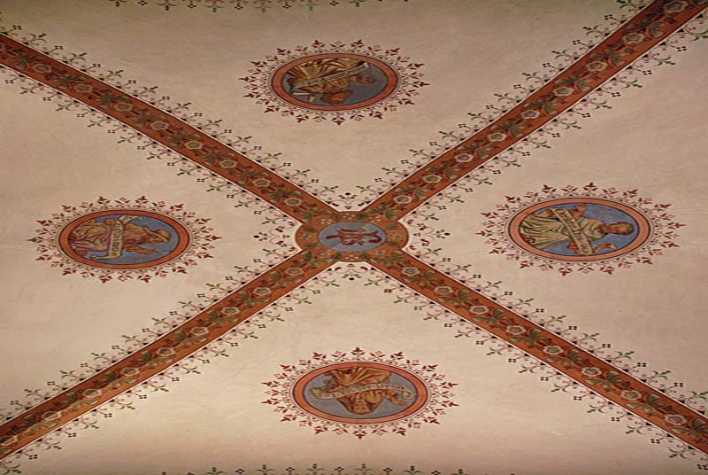
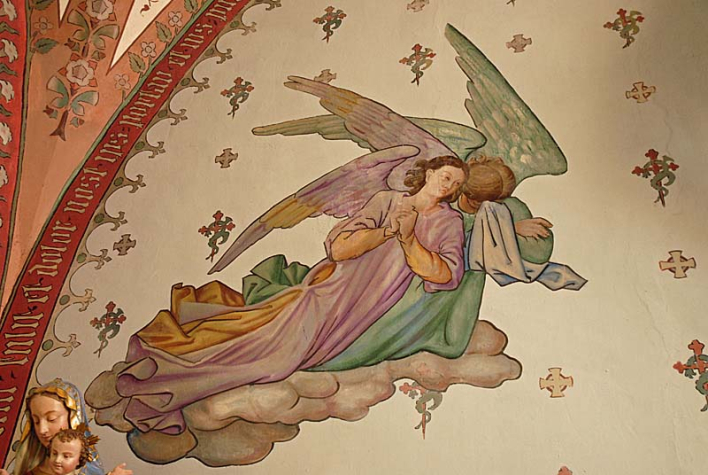
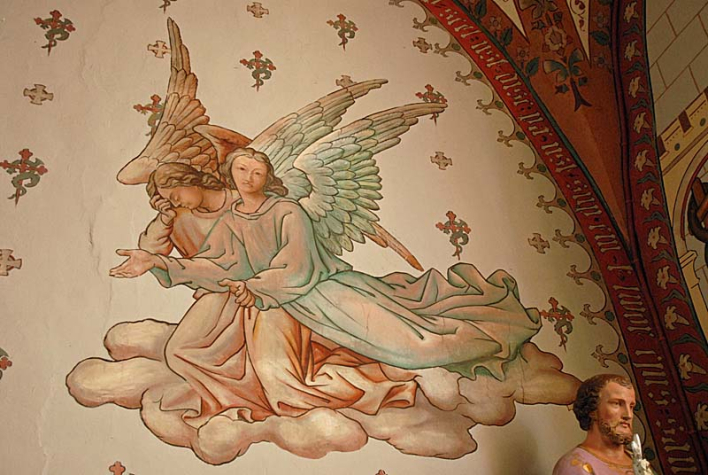
The choir is particularly interesting for its set of liturgical paintings by Abbé Ambroise Raulet (1842-1930), then inspector of diocesan works and creator of a veritable catechesis in images, which were also restored in 2010. A long Latin text in Gothic script surrounds the choir, celebrating the mystery of the Eucharist. Below, in semicircular arches, angels show the instruments of the Passion. Above the altar, Christ on the cross is surrounded by four angels kneeling on a heavenly cloud, surmounted by an inscription transcribing the words of Isaiah at the moment of the Passion. On either side of the side windows are arranged in pairs twelve figures from the Old Testament who announced the coming of Christ: to the north Abel/Noe and the prophets Elijah/Malachi, and to the south Abraham/Melchisedek and Moses/Aaron, and on the vault, each painted in a medallion, are the four great prophets Ezekiel, Jeremiah, Daniel and Isaiah.
To visit the church, which is open on Saturdays and Sundays, you can obtain a key during the week from Mr Félix Prautois at 8 Rue des Sorbiers (under the church) or from the Mayor.
Eglise Saint-Didier de Charmes