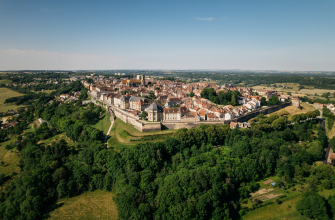
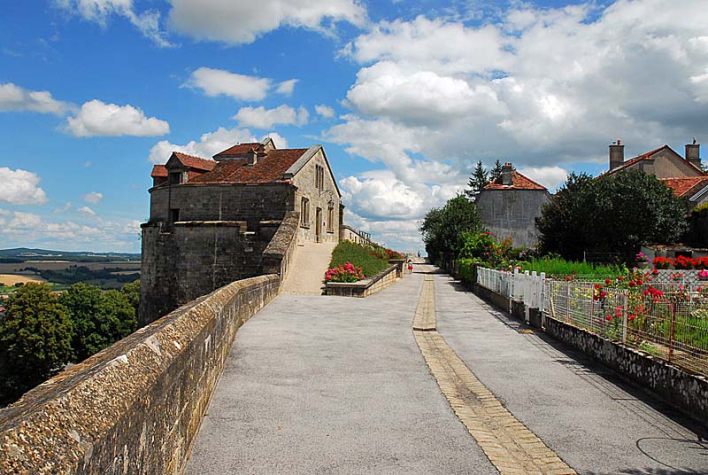
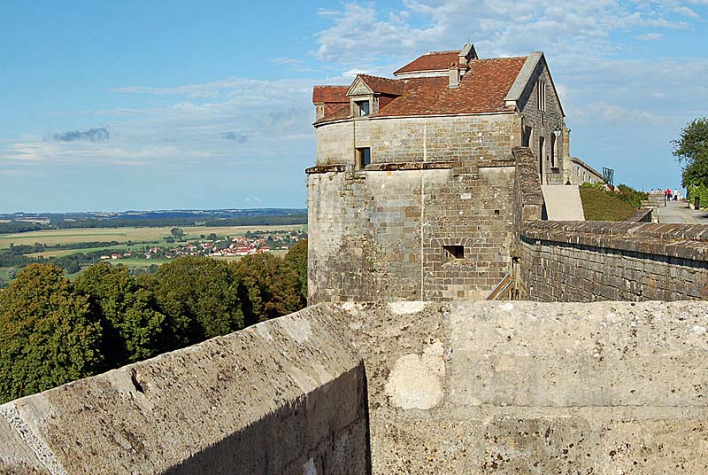
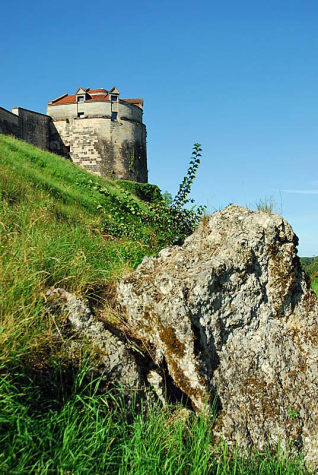
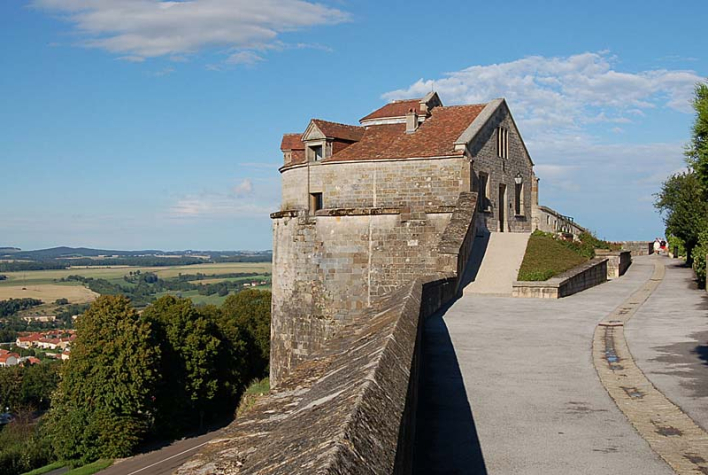
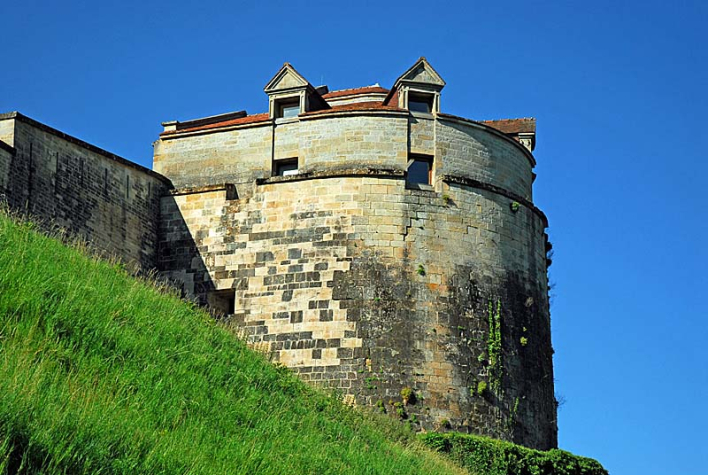
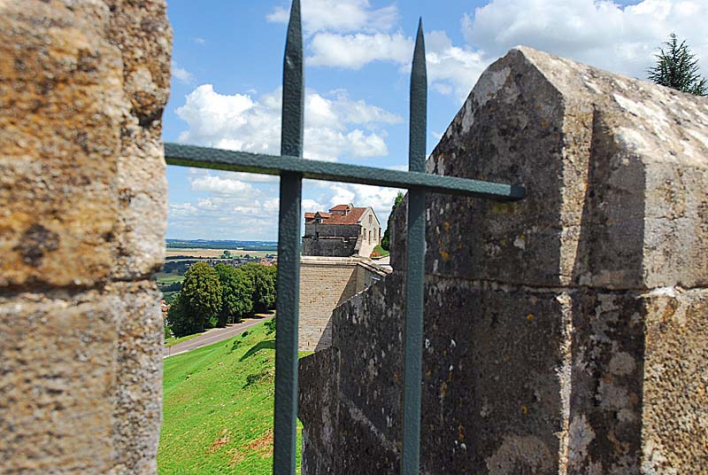
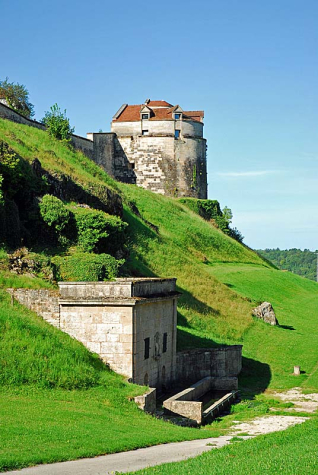
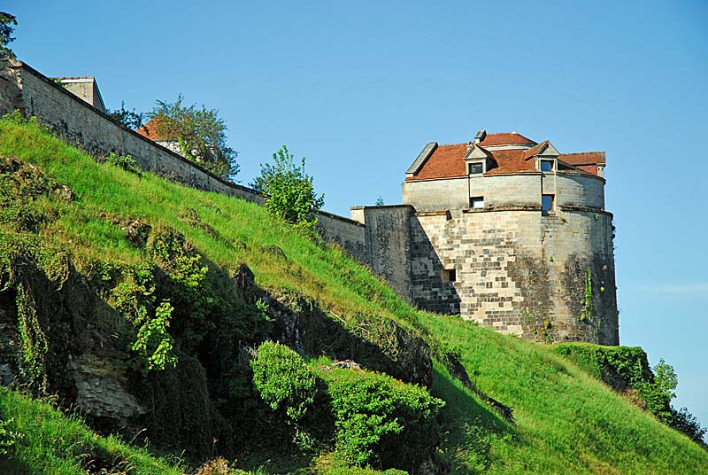
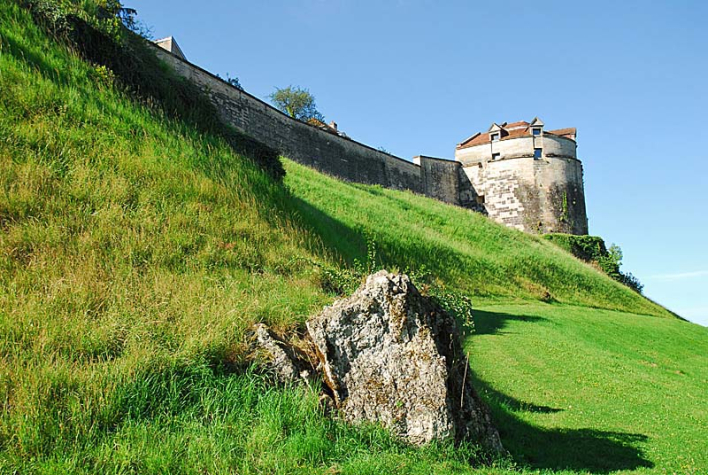
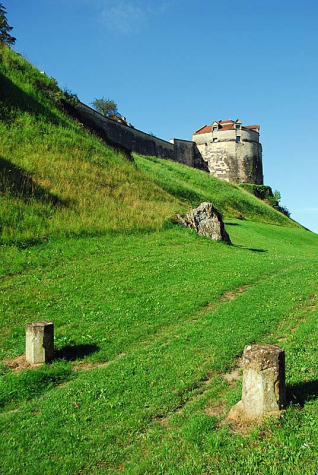
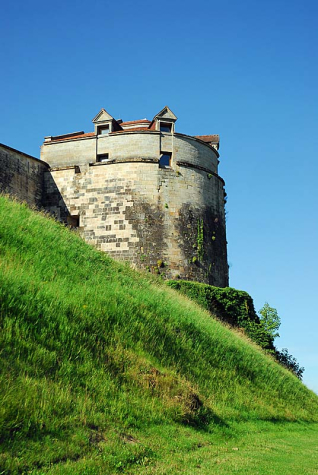
Built on a rocky spur, the Saint Jean or Saint Gengoulph tower completes and modernises the fortified walls of Langres. Contemporary with the Longe-Porte barbican, this tower owes its name to its proximity to the former Saint-Gengoulph priory, which no longer exists. Built around 1537, it was the last of the town's four artillery towers, commissioned by the King of France to protect the kingdom's eastern border. Its structure is simpler than that of its predecessors, and its originality lies in the fact that it has no firing aperture on its facade. This blind front forms a semi-cylindrical frontal shield 7.5 metres thick.
Inside, the single vaulted room contains two lateral fire casemates used to flank the curtain walls. The firepower of the structure was enhanced by the terrace, which was equipped with embrasures. The parapet of the terrace was pierced on the left and right to accommodate cannons designed to protect neighbouring defensive works.
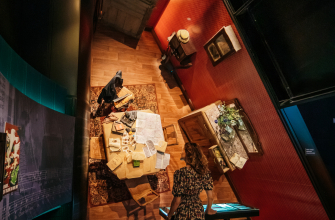
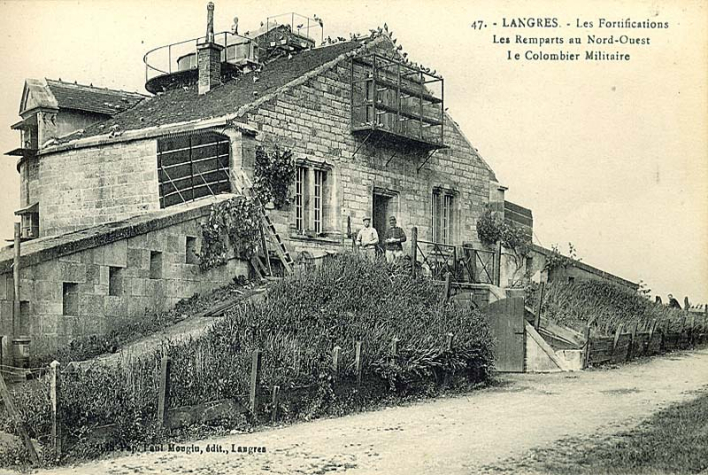
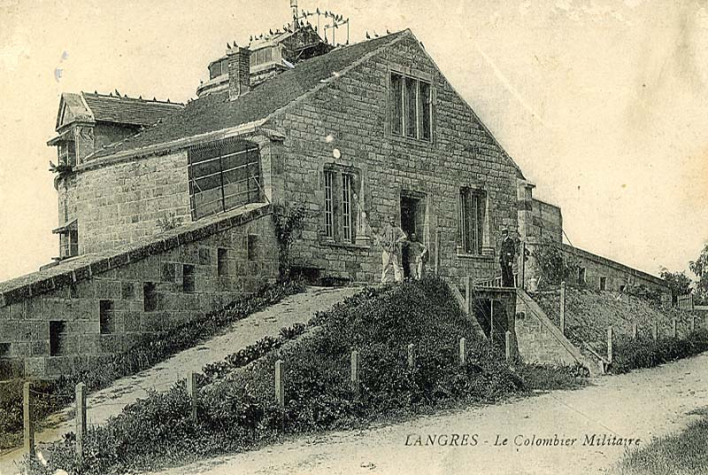
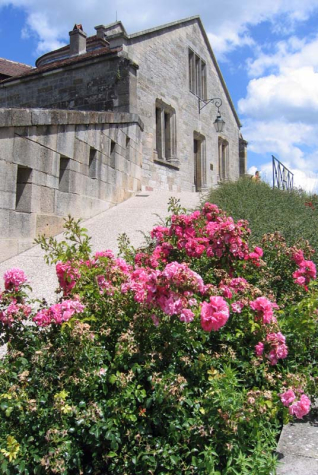
In 1882, a neo-medieval-style military dovecote was built on the tower's terrace. Carrier pigeons were used as a means of communication between border strongholds. Messages were photographed on special 6 cm² film, enlarged and deciphered by projection. This was a highly efficient means of transmission: a carrier pigeon could fly at speeds of 60 to 100 km/h and cover the Langres-Besançon route in 80 minutes, for example. This system worked until the outbreak of the First World War.
A little background information:
In 1580, an artillery inventory revealed that the tower was equipped with: a medium field gun, 2 sickle guns on carriages and 2 hook harquebuses.
In all, there were more than 130 firearms of all calibres permanently in the works, not counting the artillery stored in the arsenals. In 1567, there were 16 cannons, 23 harquebuses, more than 6 tonnes of gunpowder and a thousand cannonballs.
These weapons were not kept; at the end of the 17th century, the royal authorities disarmed the town, which was no longer on the borders. In the 18th century, only portable weapons and a few out-of-date cannons remained, to be used for police rather than military defence of the town.
Tour Saint-Jean ou Saint Gengoulph