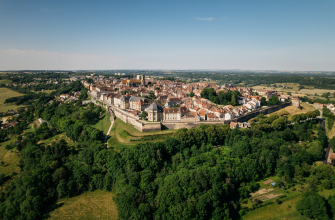
History first mentions the "castle of Nogent" in 610. It clearly marks the location of the town, on the edge of a plateau, in a strategic position. This fortress can be compared with other strongholds such as Langres, Montigny-le-Roi and Clefmont, which marked the border between the Kingdom of France and the Germanic Empire.
The grandson of Thibaut Count of Champagne inherited Nogent. On his death in 1024, the castle reverted to Rénier and then to the Duke of Burgundy.
Hugues 1st Count of Champagne and the Bishop of Langres laid siege to the castle of Nogent. On 2 May 1104, the victors donated the church of Saint Jean and the church of Saint Germain to the Abbey of Saint Bénigne in Dijon.
In 1235, Thibaut IV Count of Champagne obtained the land and castle. In 1235, Thibaut IV, King of Navarre, renamed Nogent le Roi (Nogent the King) and enfranchised its inhabitants.
During the Hundred Years' War, the town was captured by the Anglo-Burgundians.
Following the Wars of Religion, Richelieu came to power and had most of the fortresses destroyed, except for Nogent, which escaped destruction. The castle remained under the guard of a governor appointed by the king.
This defensive role was definitively abandoned at the end of the 17th century, with the occupation of Lorraine and the annexation of Franche-Comté.
The ramparts still existed at the beginning of the 18th century, but today only ruins remain.
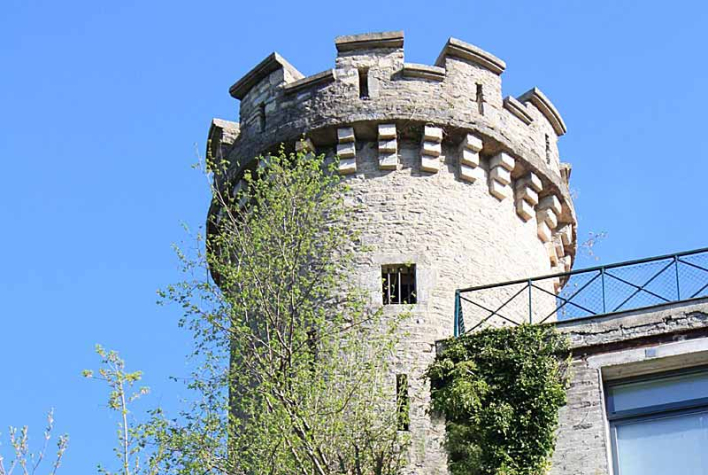
The corner tower:
Today, all that remains of the castle is the street, named as such in 1895, which leads to a tower.
This tower, known as the keep, is simply the corner tower of the spur, privately owned by the factory below and rebuilt at the end of the 19th century.
Tour d'Angle et ancien château de Nogent