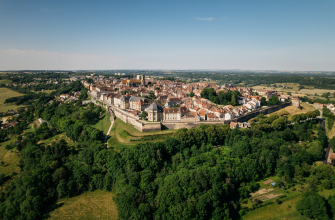
Jeanne Mance, born on 12 November 1606, was an exceptional figure in the 17th century. The second of twelve children, she devoted herself to taking the place of her father, who died in 1630, and her mother, who died in 1632. The family home was located at 11 rue Barbier d'Aucourt (then rue de l'Homme sauvage).
During her years in Langres, she devoted herself to her compatriots, coping with the war (the Thirty Years' War), the plague (5,500 victims in Langres and the surrounding area) and poverty. In contact with the city's Jesuits and news of the first French missionaries in America, she left her home town in 1640 to respond to a call to mission.
After a few months in Paris, she set sail from La Rochelle in May 1641 with around fifty companions. The expedition finally landed on a deserted island in the St. Lawrence, Montreal, on 17 May 1642: Ville-Marie - the first name of the city that became Montreal - was founded. As a nurse, steward and right-hand woman to Governor Paul Chomedey de Maisonneuve, she used her talents to serve the French and the Amerindians without distinction.
She crossed the Atlantic three times to bring relief to the threatened little town.
A free spirit, she always rejected the idea of joining a religious order. Jeanne Mance, assisted by her friend Marguerite Bourgeoys, died on 18 June 1673 at Hôtel-Dieu, where she was buried after handing over her hospital to the Hospitalières de Saint-Joseph. Jeanne Mance is the only one of the pioneers of Montreal to be buried on this land.
The only 'man' in the colony during the governor's many absences, she remains a model for contemporary feminist circles in North America.
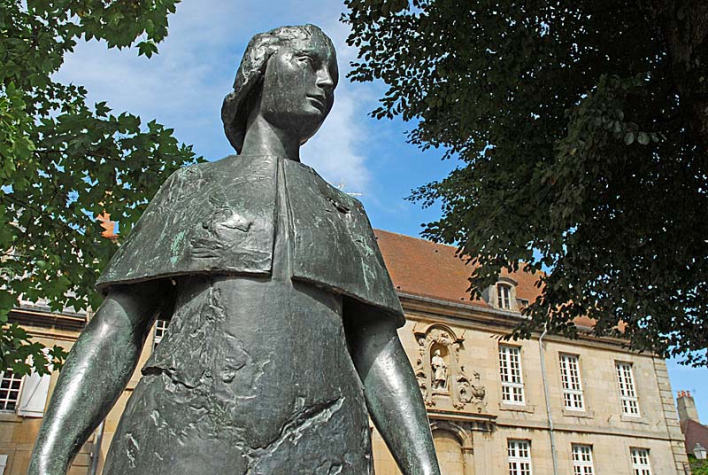
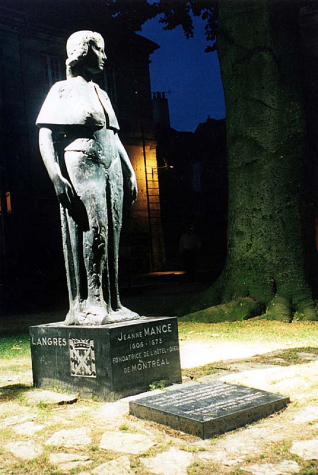
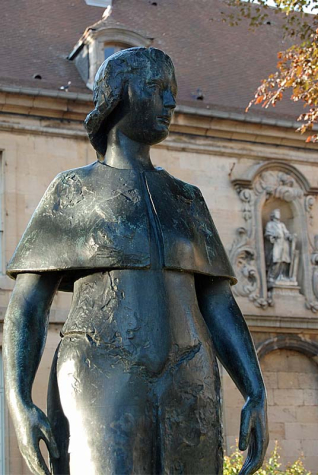
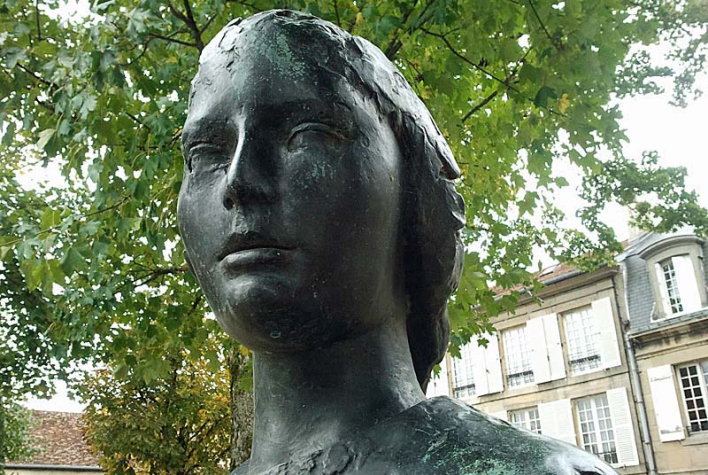
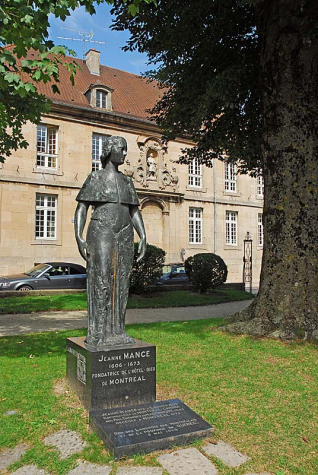
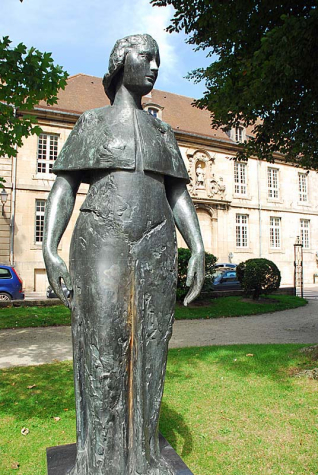
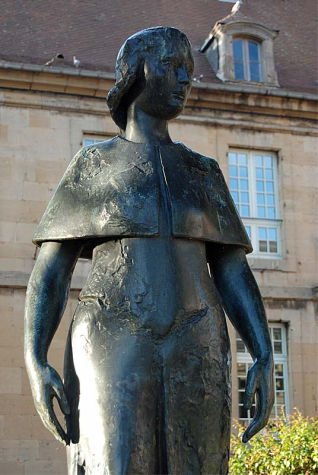
The statue, the work of sculptor Jean Cardot, was erected in front of the Cathedral on 5 May 1968. This was once the site of the church of St Pierre-St Paul, where Jeanne was baptised on 12 November 1606.
On 17 May 2012, the City of Montreal officially recognised Jeanne Mance as co-founder of the city.
In November 2014, the Vatican recognised Jeanne Mance's "heroic virtues" by proclaiming her Venerable.
The Langres - Montreal Association
Jeanne Mance Cultural Centre
The association, along with the Montréal-Langres committee, was behind the erection of the statue of Jeanne Mance on 5 May 1968.
It promotes the work of Jeanne Mance, develops relations and cultural, tourist, sporting and economic exchanges between the Langres region and Montreal, Quebec and Canada, and promotes the French-speaking world.
It organises shows, conferences, publications, trips, festivals, exchanges, symposiums, etc.
It is an active member of the Fédération France-Québec.
Statue de Jeanne Mance