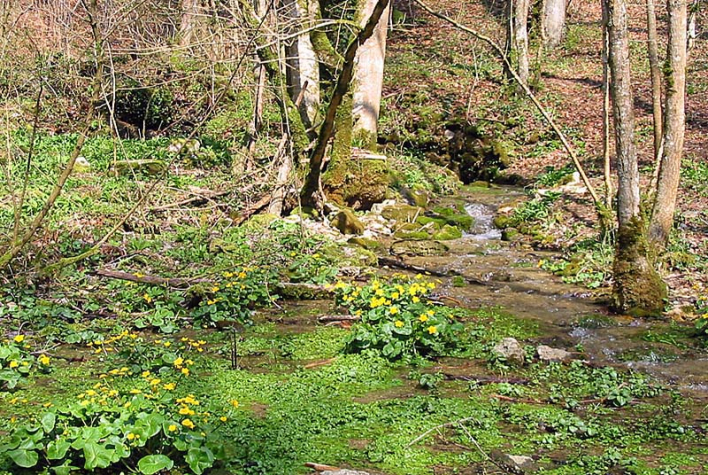
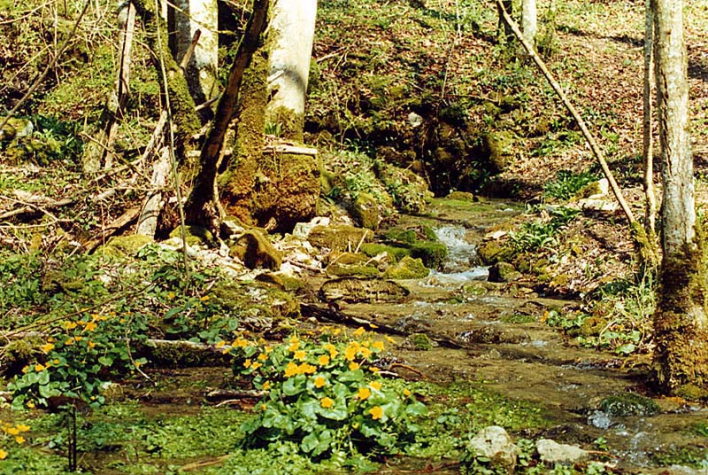
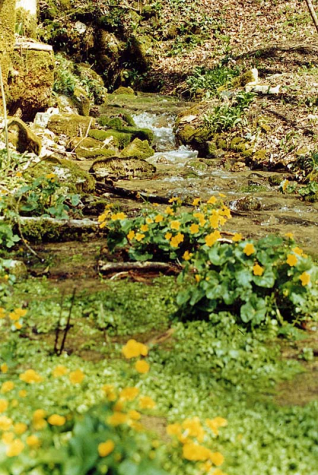
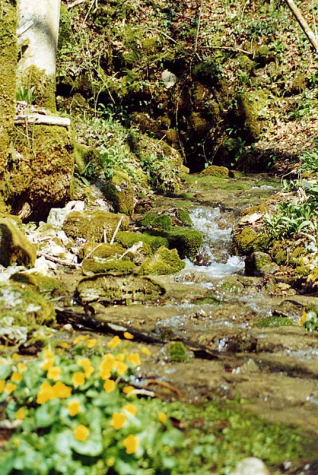
The Vingeanne is formed by two streams coming together:
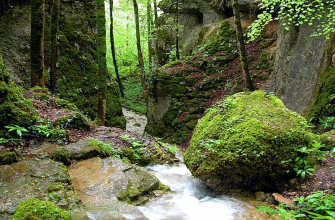
- To the north, the source of Combe Royer, the only "canyon" in Haute-Marne carved by water into the limestone terrain. It is considered the "official" geographical source.
- To the south, the other spring is shown on the IGN map.
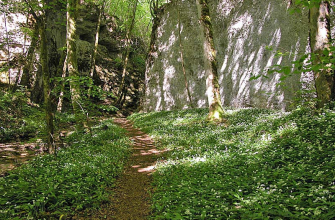
In May, a carpet of wild garlic will accompany you on your discovery. The trail is covered in the white stars of the garlic and its stunning fragrance...

Discovery trail available on the free Id-Vizit app!
A real personal travel companion, Id-Vizit offers you personalised, fun and interactive tours!
+ More info on Id-Vizit
For nature lovers :
The ZNIEFF of the sources of the Vingeanne, part of the large type II ZNIEFF of the eastern Auberive forest massif and the Bois de Baissey, groups together a series of former pastures established on marl soils, now largely reforested.
Two areas are still of great interest: the Rosière marsh, a tufa marsh typical of the Langres Plateau (schoenaie, cariçaie, moliniaie) and an area covered with alternating dry and wet grassland, the last remaining example of this type of grouping in Haute-Marne.
Vegetation:
The vegetation includes more than a dozen rare or protected species, such as the choin ferrugineux (nationally protected), the herminie clandestine which has its only station here in Champagne-Ardenne, two other orchids (the vanilla-scented gymnadenia and the incarnate orchis), the creeping willow, the broad-leaved linaigrette, etc. One species here is at the northern limit of its distribution, the common reed, which is rare in Haute-Marne. All these species are on the red list of plants in Champagne-Ardenne.
Fauna:
The entomofauna is rich and diverse and includes many rare or threatened species: For dragonflies, the agrion de Mercure, protected in France since 1993, included on the international lists of the Habitats Directive and the Bern Convention, on the red list of French fauna as a species threatened with extinction in the northern half of France, the ringed cordulégastre, of mountain origin, rare throughout France but well represented on the Langres plateau and included on the red list of insects in Champagne-Ardenne.
Six crickets are included on the Orthoptera red list: singing crickets (vagrant cricket, mountain cricket and small-winged cricket), coloured crickets (blue oedipod), migratory crickets (Italian cricket) and a grasshopper found in wetlands with luxuriant vegetation (small-winged grasshopper).
Three butterflies are on the regional red list: the peacock butterfly (Ino), which prefers marshy meadows and light, damp woods, the hermit butterfly (very rare on the plains) and the russet skipper.
The praying mantis and a small cicada, the mountain cicadette, are also present.
The asp viper and the salamander (on the regional red list) have also been spotted within the ZNIEFF perimeter.
The site has been protected since 1987 by a biotope protection order covering almost the entire ZNIEFF.
Source de la Vingeanne