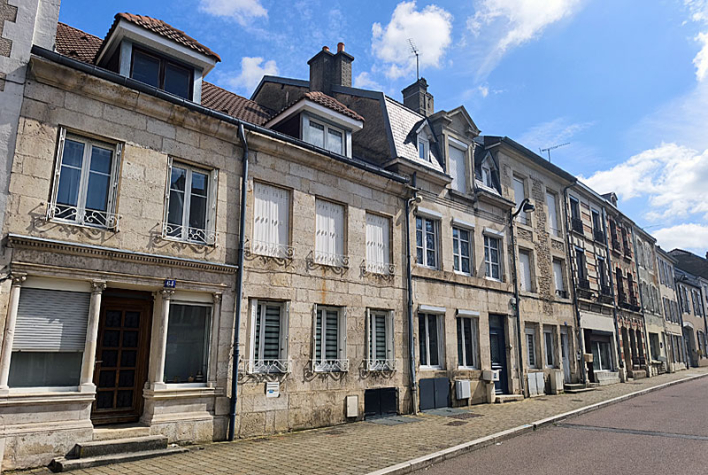
This is the rue du Maréchal De Lattre De Tassigny, formerly known as the "grande rue". Around 1875, there were many wholesale traders here. It was in this street that workers would come on Sundays to offer their week's work to the highest bidder. At no. 58 was the Guillemin-Renaut trading house, from which most of the cutlery in the museum comes.
The street features a fine row of narrow facades dating from the 18th and 19th centuries. Ashlar is often used. Sometimes it is combined with brick, in successive horizontal rows, to form the so-called "champenois" bond.
As you head towards the Place de la Mairie, you can see a number of fine houses, a break with the working-class architecture.
The former vicarage, at no. 39 on the right, is of neo-classical architecture.
On your left, at number 22, the Café de Paris has retained its original décor, with a fine stone cornice.
At no. 18, the interesting creation by Chaumont architect Ronot, for the son of a wealthy merchant and cutlery trader, René Chevry, himself a master cutler, renowned for his small penknives worn as pendants. The decor is almost Parisian, with green and pink marble.
Also of note is the beautifully sculpted facade at no. 14, marked Drioux and dated 1876.
Rue Maréchal De Lattre de Tassigny