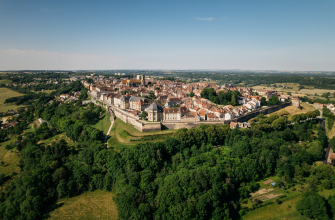
Semi-natural dry grassland where it is relatively easy to spot remarkable orchids in season.
For nature lovers:
The ZNIEFF limestone grasslands of Dommarien, Prauthoy and Montsaugeon comprises seven relict grasslands scattered across the territories of three communes in the south-east of Haute-Marne: one in Montsaugeon between le Carron and sur les Roches, two to the east of Dommarien towards les Charmes, three between Dommarien and Prauthoy, at sous la Perrière, Fontenoille and les Quatre Groseillers and to the north of Prauthoy, the Mont Musard clearing.
Vegetation:
Their vegetation is characteristic: Alysso-Sedion on the limestone slabs, Mesobromion and locally Xerobromomion. They are all more or less overgrown with thorny blackthorn and juniper and colonised by pine trees. Their flora is typical and includes a number of rare and protected species: the blood cranesbill (only on Mont Musard), the germander orobanche, a sub-Mediterranean parasitic plant that is fairly rare in France and is in decline (it does not cope well with competition from vegetation and the densification of vegetation) and the houndstooth andropogon, of southern origin, which is very rare north of Paris and, in the Champagne region, is mainly found at the southern end of the Haute-Marne. All three are protected at regional level and included on the red list of endangered plants in Champagne-Ardenne, along with the Apennine helianthemum, a Mediterranean species close to the northern limit of its distribution, the fumana vulgaris, thyme broomrape, spider ophrys, humble sedge, yellow odontitis, dwarf bugrane, a sub-Mediterranean species that is rare in Champagne-Ardenne and found only in the driest areas, and fasciculated minuartia, which is at the very edge of its range in Haute-Marne. An end-of-range fescue (Festuca burgundiana) is also found here.
Fauna:
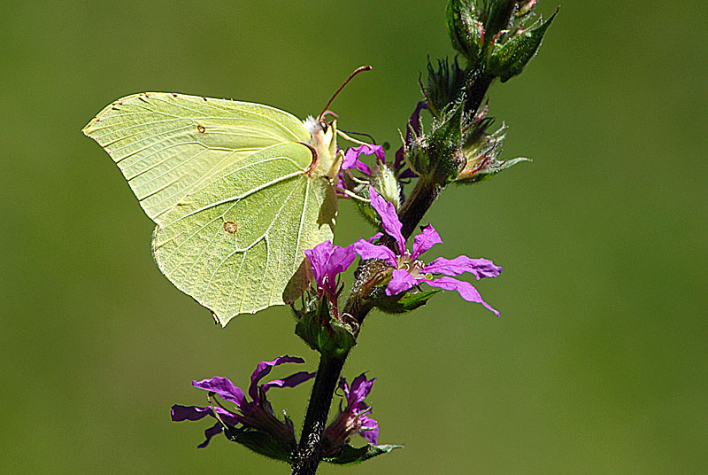
The entomofauna is rich and diverse, with the same biogeographical tonality as some of the flora, with the presence of the praying mantis, the small mountain cicada, a southern Neptroptera, the ascalaphe (Ascalaphus longicornis), a spider (Argiope bruennichi), various orthopterans including some colourful song crickets (blue oedipod, German oedipod, etc.), the Italian cricket and some species of the common cricket.This small, brilliantly-coloured butterfly is rare and endangered in Europe (Annex II of the Bern Convention and Annex IV of the Habitats Directive), has been protected in France since 1993, is listed in the Red Book of threatened fauna in France and is on the Red List of insects in Champagne-Ardenne.
The green lizard and asp viper are well represented. The site is frequented by a number of bird species, including the woodlark, a rare breeder in Champagne-Ardenne and on the regional red list of birds. The grasslands are also of interest for hunting (hare, wild rabbit) and landscaping. They are subject to overgrowth and the natural spread of nearby pine trees (black pine or Scots pine stands). Some, such as at Dommarien, are protected by the local authority, while the one at Montsaugeon has been managed (by clearing undergrowth). In general, all are in a fairly good state of conservation, with the one at Montsaugeon in good condition.
Pelouse sèche du Mont Musard