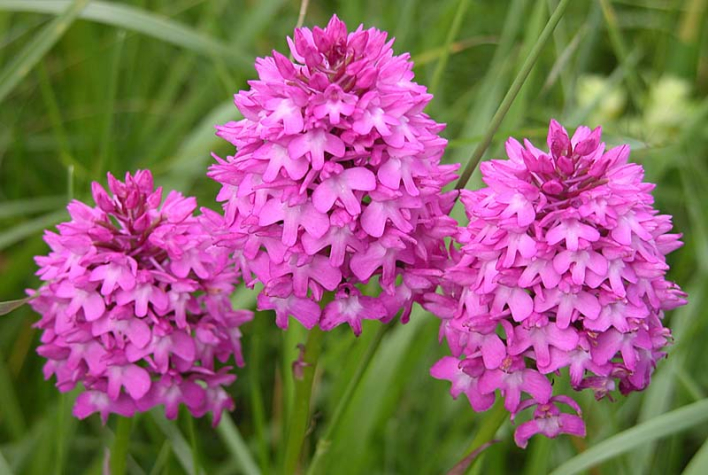
Semi-natural dry grassland where it is relatively easy to spot remarkable orchids in season.
For nature lovers:
The ZNIEFF des anciennes lavières de Dardenay is located on the limestone plateau to the south-east of the village. It includes former wash pits (quarries used to extract limestone slabs known as laves), where characteristic low-lying vegetation (Stipion calamagrostidis on the small screes, Alysso-Sedion on the limestone slabs, Mesobromion), scrub and secondary woodland have re-established themselves following the abandonment of mining.
It is home to numerous orchids, including Jura ophrys (on the regional red list), bee and bumblebee ophrys, as well as their very rare hybrid (Ophrys albertiana), species typical of the grassland (globularia, coronilla minima, various orpins, etc.), grasses including one of the most abundant in the region.), grasses including an uncommon fescue at the edge of its range in Haute-Marne (Festuca burgundiana) and four other species on the red list of endangered plants in Champagne-Ardenne: the thyme broomrape, the Apennine helianthemum, the right micropus, very rare in Champagne-Ardenne and in the lavières, and the narrow-leaved centranthe, rare and highly endangered, at the edge of its range. The entomofauna is characterised by the presence of two southern species, the praying mantis and the mountain cicadette. The green lizard (Annex IV of the Habitats Directive), which is close to the northern limit of its range, is also well represented. The ZNIEFF is increasingly overgrown with shrubs, saplings and pine trees; this overgrowth is the main threat to the grassland, along with the (still very localised) spoil deposits that have led to the filling in of a gully on the site.
Pelouse sèche des anciennes lavières