The massacre of 9 August 1944.
At 9pm on 9 August 1944, the inhabitants of Saint-Broingt-les-Fosses heard two loud bangs. Soon, a high column of smoke rose from the trench opposite the Suxy farm. The villagers, realising that it was probably an attack on the railway line, were not overly alarmed.
At 9.15pm, Mrs Marcel Perrin saw flames rising from a building on the farm. The residents quickly gathered around Mr Regnier's garden, which provided a good vantage point for observing the fire. The fire started in the barns, then spread to the wine press, down towards the chapel, reached the building to the left of the house, then the one on the right. Soon the farmers' house was engulfed in flames.
Mr Regnier's son sounded the town's alarm. Firemen set off in the direction of the farmhouse. The residents heard gunshots coming from the same direction as the fire. Fearing reprisals, they did not lie down, ready to flee. For a long time, the glow of the fire lit up the sky. As night fell, calm settled over the Suxy farm, reduced to a few sinister black walls emerging from the last wisps of smoke mixed with the morning fog.
What had happened? Mr André Rigollot, a schoolteacher in Saint-Broingt-les-Fosses, went to Villegusien early in the morning to visit the brother of the farmer (Paul Fourot) and was able to report the following on his return.
As a train (1) of German paratroopers, 150 SS (shock troops), was climbing the ramp into the trench, a small machine, placed against a rail, exploded, causing a slight derailment. No-one was injured. Only two wagons left the track.
The soldiers, intoxicated by the cognac they had drunk during the journey and enraged by the attack, rushed back to the farm, shouting at the top of their voices, while others headed for Prauthoy along the railway line (2).
At that hour, the farm workers were returning from working in the fields. Madame René Fourot, the owner, was in the kitchen with her daughter, her great-niece Cécile, and Madame Hans, the cook. Mr René Fourot and his grandson Robert are in Villegusien.
Using grenades, the Germans set fire to the building to the right of the house and arrested Madame Fourot, the children and all the men in the courtyard. Madame Fourot, who had had time to telephone her husband and Robert to tell them not to return to the farm, was asked to rescue her most precious possessions from the house; a German even helped her to transport some sheets that were never found. The two suitcases, full of her most prized possessions, were snatched from her hands as soon as she stepped out into the courtyard and disappeared. Mrs Fourot, Mrs Hans and the children were placed at the foot of a tree near the bridge over the railway line, under orders not to move. Soon the house was ablaze.
Despite the telephone call, Mr René Fourot, worried about the fate of his family and staff, cycled back to the farm.
As soon as he arrived, he asked who had started the fire; he was quickly surrounded by around ten Germans. The farmer wants to speak to their leader.
The scene unfolds at the right-hand corner of the bridge; an SS man pulls a dagger from his boot and presses it against Mr Fourot's chest, trying to make him confess that he is a terrorist leader. Mr Fourot could not confess to what he had never been; the dagger sank deeper and deeper into his flesh, and the unfortunate man was pushed onto the embankment that sloped down to the track. There he shouted to his wife, "Goodbye my wife, goodbye my wife". A burst of machine-gun fire seriously injured him as he fell.
Mr Fourot, who had been stabbed and then machine-gunned (later confirmed by Dr Jeanneret, accompanied by Gendarme Rigonnot from Prauthoy), fell to the right of the bridge. His body was found on the left, so his death was not instantaneous.
Mrs Fourot, the wife, was able to have the two girls taken to Villegusien, thanks to the help of Mr Kesseler from Saint - Broingt - les Fosses. It will never be known when the farm servants were killed. Was it during the night? On the morning of the 10th? There was a great deal of confusion at the scene, with the Germans firing at random and at any moment. The soldiers stopped a car coming from Chaumont, occupied by two young men, and ordered the driver, after getting a passenger out, to take Madame Fourot and Madame Hans wherever they wanted. The two women took refuge in Villegusien with Mr Paul Fourot.
The day after the tragedy, the Feldgendarmerie, the Prauthoy gendarmerie, the gendarmerie captain and Dr Jeanneret, the forensic doctor, arrived at the scene to investigate and establish the facts. They found two servants killed in the trench, not far from the body of Mr Fourot, others lying in a heap in the ditch beside the road, covered in faggots, and three bodies in the woods of Montmusard, above the farm. The Germans would have put FFI armbands on these unfortunate men and probably photographed them as well.
Neither Mr Fourot nor his servants were members of the FFI. They were all returning from work. The inhabitants of the farm close to the railway line would not have been so foolish as to sabotage the line in front of their home.
In addition to the victims from Suxy, there were three unknown men, who were probably just passing through. One of them had his left ring finger cut off to make it easier to steal his wedding ring.
As for Madame Fourot, she was unable to save anything from her farm and left with the shoes and clothes she was wearing.
In the vicinity of the farm, two innocent people were shot dead: Manuel, a Portuguese labourer living in a house in La Sordelle, who was returning from work, and Adrien Valroff, a farmhand living at the La Sordelle gate, whose wife and three children had come to live in Saint-Broingt-les-Fosses for a while.
Some of the Germans who got off the train followed the railway line towards Prauthoy and arrived in the village, some via the Cognelot, others via the station road. Along the way, they shot Mr Robert Gy as he brought his herd back to the village. Even the dog was not spared. Hearing the shots, some of the inhabitants of Prauthoy, who had set off in the direction of the farm and wanted to turn back, ran into the killers. Roland Viard, a shoemaker and father of four, Prétet, father of one, and Bechtold (a collaborator) were shot dead with pistols. Young Jacques Gy was shot through the neck (he survived) and his brother Fernand was only threatened but miraculously spared because he was accompanying the victims.
Germans poured into Prauthoy, disarming the gendarmes and terrorising the butcher and the chemist. Haystacks were set on fire not far from the Cognelot barrier. If it hadn't been for the intervention of Germans who had been living in Prauthoy for a few weeks, and who negotiated with their comrades on the train, Prauthoy would certainly have been set on fire, as equipment for this task had supposedly been brought to the site.
Following this event, the Commanding Officer of the Suxy train wanted hostages: the Mayor and 20 men, then, changing his mind the day after the events, the Mayor and 10 men. Pierre Mathey, the Mayor, accompanied by two Germans living in the village, went to see the train commander, telling him that he would never bring 10 men, leaving him to choose them himself. The discussion went on for a long time towards the train, but finally, thanks to the courageous mayor, matters were settled and no hostages were asked for. At half past noon, the train set off again for Langres.
1: Train (46)224, service number 132429 to Chalindrey and (15) 243 from Chalindrey to Neufchâteau, from Grenoble, via Lyon, Mâcon and Dijon.
2: Taking advantage of a moment when surveillance was relaxed, the locomotive engineers climbed back on their engine, stalled and sped off towards Villegusien.
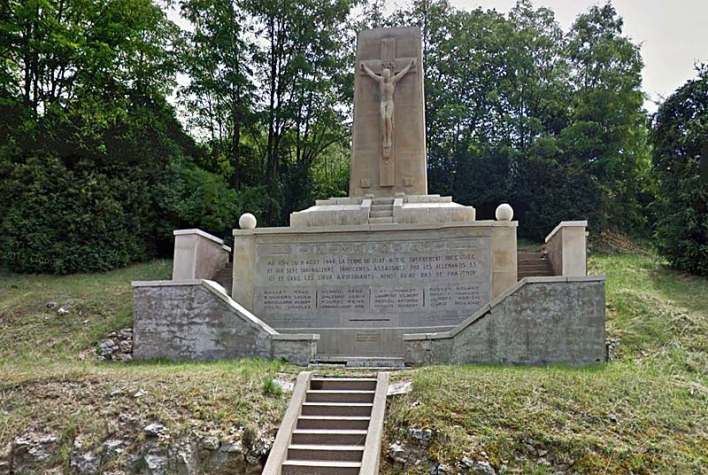
The monument commemorating the massacre of 9 August 1944 on the RN 74 bears the following inscriptions:
Inscription to the left and right of Christ on the Cross.
Left: "Faced with the martyrs of hatred and violence, people must fight against their ignorance, help each other, complement each other, in order to better order and harmonise needs.
Right: "strive to define and reconcile responsibilities in order to make their solidarity effective, unite their efforts and cooperate in their progressive unity in diversity.
IN - MEMORIAM" inscription.
On the evening of 9 August 1944, the Suxy farm was completely burnt down and seventeen innocent workers murdered by the SS Germans here and in the surrounding area, as well as at the bottom of Prauthoy.
Ballet René, Bonnard Lucien, Brouillard Albert, Colin Charles, Cornu René, Dalensy Louis, Fourot René, Grandclaude Aimé, Gy Robert, Laurent Gilbert, Manoel Antonio, Midoux Robert, Philippe François, Pretet Roland, Valroff Adrien, Viard Roland.
Architects: G et J Tréhant - Mathé, in Paris.
Statuary: Lagpiffoul
Monument contractor: M. Dubois.
Masonry contractor: J. Jayet.
Credit: Jean Rigollot, my late father André Rigollot (his handwritten notes), and Robert Fourot (son of the farmer of the Suxy farm).
Monument commémoratif de la ferme de Suxy