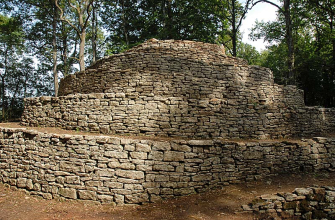
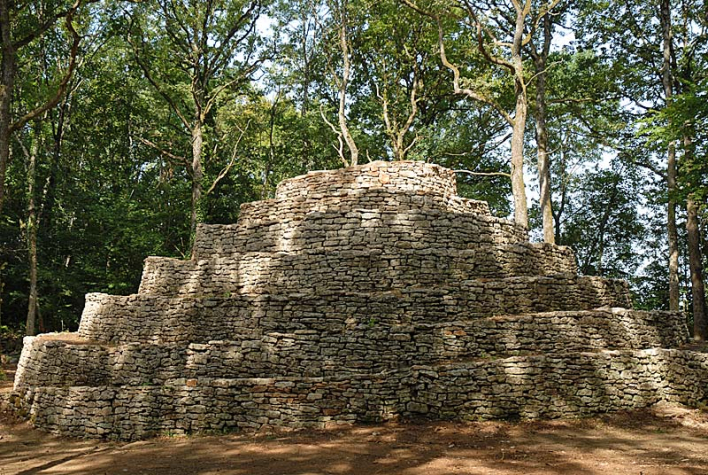
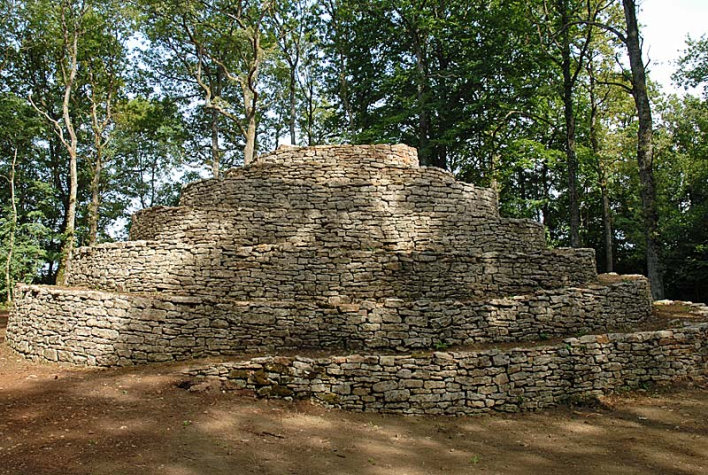
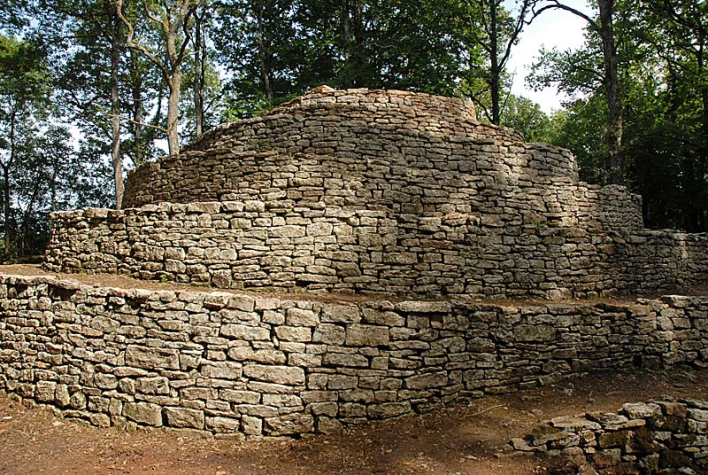
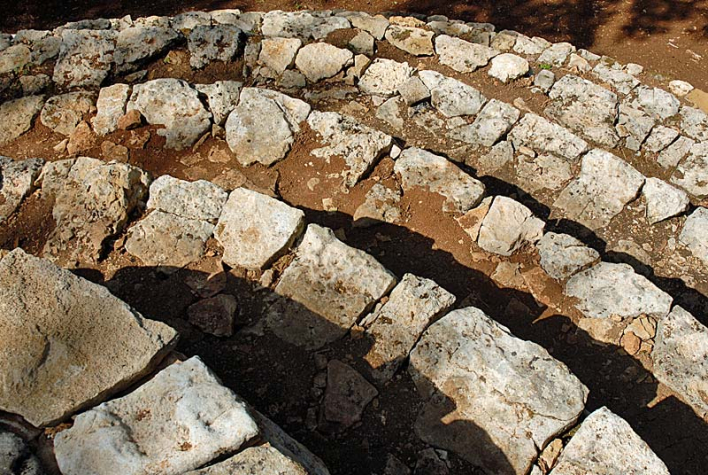
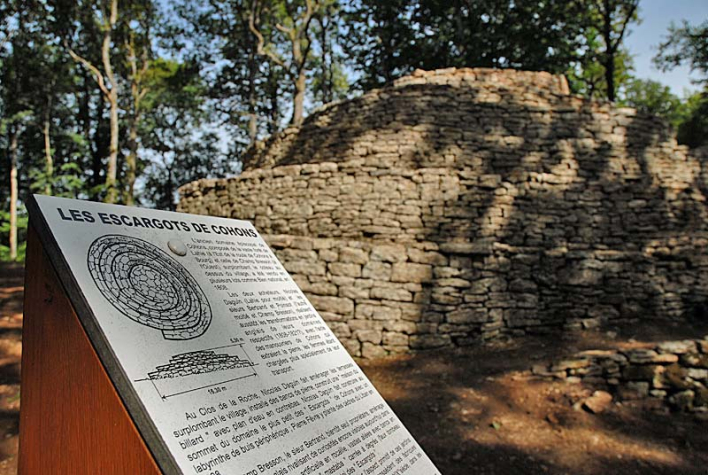
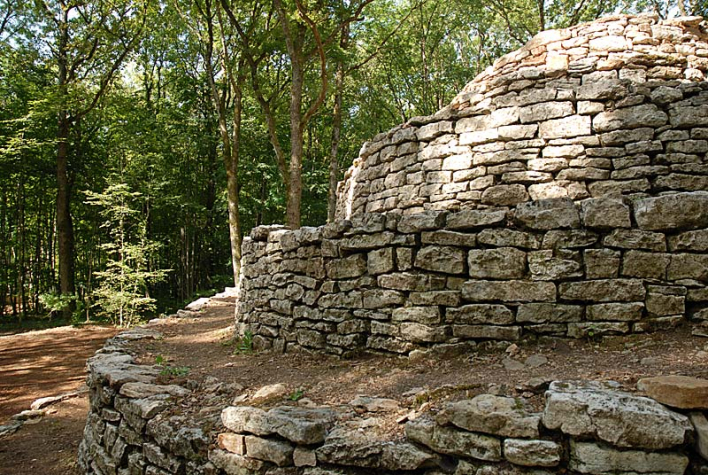
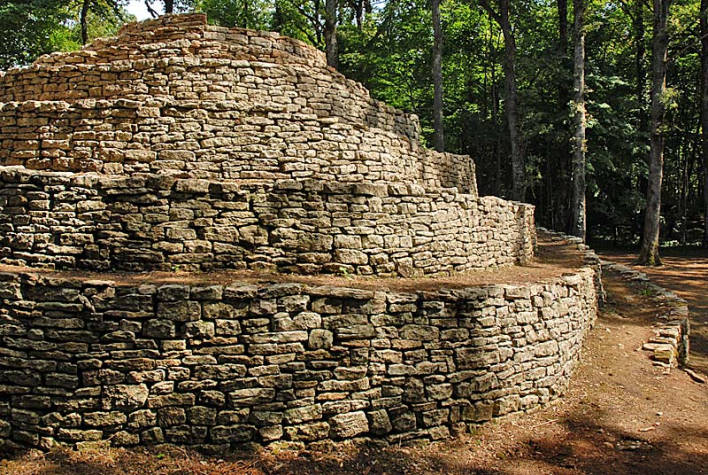
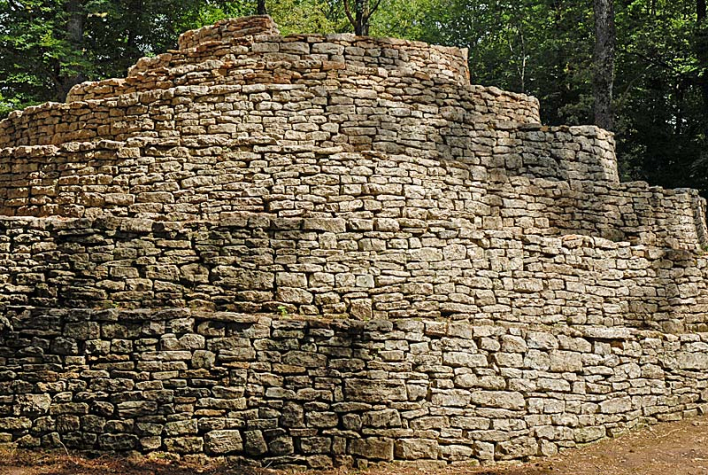
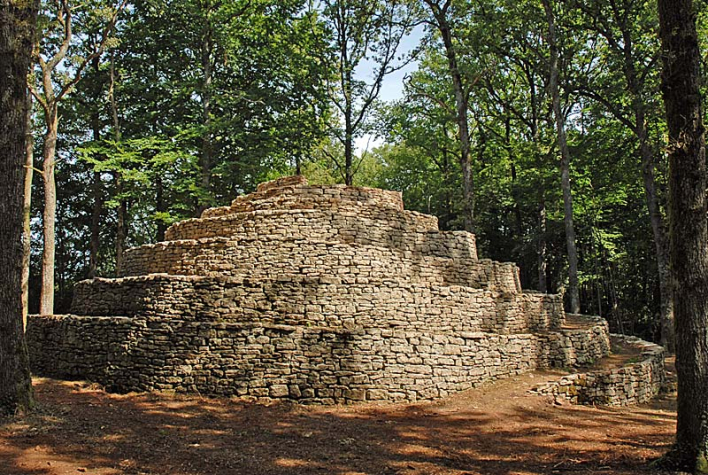
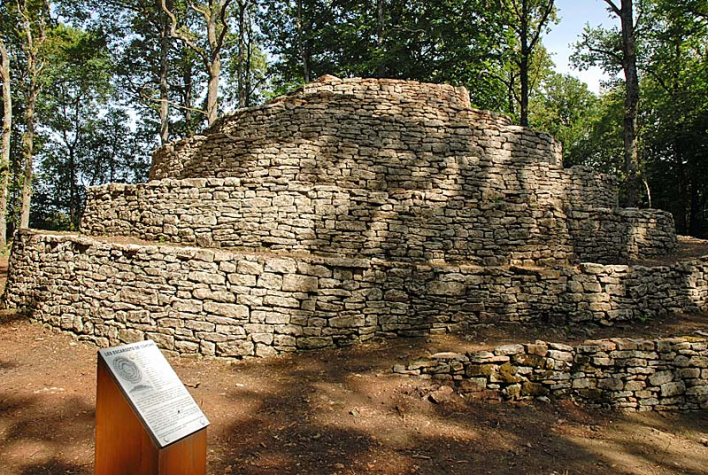
Climbing to the very top of the hill, you can enter an undergrowth surrounded by walls, in which sits a curious dry stone structure in the shape of a truncated cone supporting a spiral path around its perimeter, forming terraces up to a summit platform. This is one of only fifteen buildings known to date in the southern half of the département, and was once located in a garden no longer overgrown by undergrowth.
These snails, veritable garden factories, first appeared in the English gardens of the region in the early 19th century. They were a fun or functional way to surprise visitors and enhance their stay, but disappeared at the beginning of the 20th century when much wiser landscaped parks appeared.
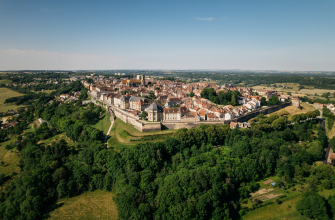
The garden, which has now disappeared, came from part of the former episcopal estate of Cohons, made up of the vast forest of Champ Bresson (where we are) and that of Lahie overlooking the village (on the other side of the road), which was sold as national property on 26 April 1808 at the end of the Revolution.
The two buyers, Nicolas Daguin, former mayor of Langres ? 1795-97 ? (half of Lahie) and François Bertrand-Poinsot, a lawyer in Langres, and Charles-Michel Poinsot, his brother-in-law (the other half of Lahie and Champ Bresson), immediately had their estates transformed into English gardens, thanks to the Cohons labourers who quarried and transported the stone. At Lahie, Nicolas Daguin had the terraces overlooking the village landscaped, planting two magnificent cedar trees (beheaded in the storm of 1999), installing stone benches, setting up the "billiard house" (which has recently disappeared) in a crevice of the cliff, and building the smallest of the Escargots on the edge of the plateau, surrounded by a boxwood labyrinth.
At Champ Bresson, Sieur Bertrand, who soon became the sole owner, had another English garden laid out, rivalling the curiosities still visible under the undergrowth: An artificial rock grotto, wide paths lined with stone benches, a "billiard house" (a type of croquet game), which has now disappeared, in a clearing with a pond, and on the edge of the plateau, a square stepped mastaba inspired by primitive Pharaonic tombs, as well as the most monumental of dry stone snails in the shape of a truncated cone. All original creations, unique in the region, perfectly in tune with 19th-century tastes in ornamental gardens of the period.
The snails of the southern Haute-Marne: In the southern Haute-Marne (from the Côte d'Or to the Haute-Saône), there are around fifteen dry-stone aediculae commonly known as "Escargots". Derived from the tradition of the older "labyrinth-buttes", the "Escargots" are truncated cone-shaped and support successive terraces on their periphery, or more generally a spiral path running from the base to the top.
These "Escargots" appeared after the Revolution in the English gardens of the region, in the same way and for the same purpose as the garden factories that were very much in vogue at the time. They developed in the south of the Haute-Marne throughout the 19th century in parallel with the fashion for English gardens, before disappearing with them at the beginning of the following century, gradually giving way to the fashion for landscaped parks, in the Langres region as elsewhere.
Snails" are original ornaments in the vernacular heritage of the Langres region, a testimony to the tastes and landscape entertainments in use during the Romantic period. Whether playful or functional, the "Escargots" all have a belvedere-shaped top that could provide original views.
Le grand « Escargot » de Cohons