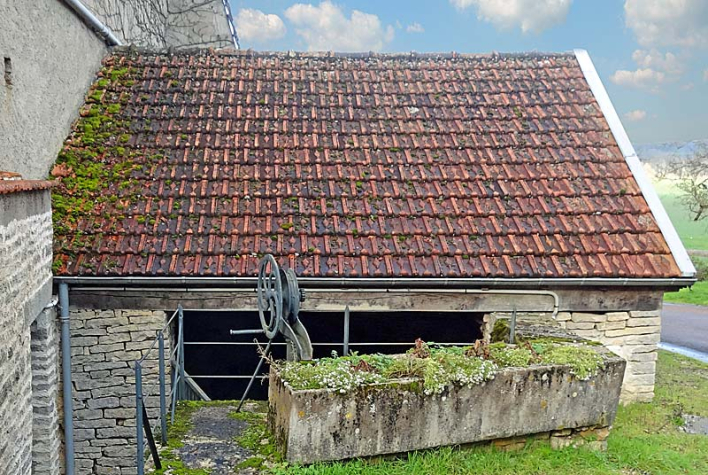
Until 1847, Montsaugeon only had one small fountain in the village, the Fontaine de la Goubaud at the end of the rue de la Goubaud, and the inconvenient Fontaine de la Vilain below the village. There were also several private wells about a dozen metres deep in the rue de la Goubaud, and a public well under the covered market (halles) supplied a drinking trough, which was only installed at the end of the 19th century.
The Fontaine de la Goubaud (which seems to derive its name from the Latin vadum = ford + the Germanic personal name Baud, Bald), must in the distant past have been a spring that cut the street by a ford bearing the name of the beneficiary of a possible toll, or of a close neighbour. In 1822, this modest fountain was in a very poor state of repair and in need of major repairs. However, pressure from the residents (particularly the women), who had long been calling for a covered washhouse to be built in place of the fountain, led to its construction being considerably delayed due to a lack of public funds...
After a long period of reflection, and in order to protect the commune's finances, the municipality decided in January 1847 "that a collection would be made at home for the proceeds, either in money or in kind, to be used for the construction of a covered public washhouse ... ... particularly for the country's Manouvrière industry, which draws most of its sustenance from the quarries on the commune's territory".
The initial funds raised and materials supplied enabled the first works to be carried out without delay, but soon proved insufficient to complete the work. So, in July 1847, the municipality voted an additional sum of 300 francs, which would allow the work to proceed smoothly and be completed.
The entablatures and fountain basin were made of Prauthoy stone, and it was Victor Jupille, a "stone mason and contractor in Prauthoy", who was to carry out the work on the covered public wash-house at La Goubaud and its roof, at the same time as that of the church. Because of the slope of the land, the fountain-washhouse was curiously built on two levels, with the wash basin below a drinking trough overlooking it, the latter fed by a hand pump installed on the spring and acting as a fountain on the street.
Thirty years later, the fountain-washhouse was in a pitiful state: the roof was in danger of ruin, a situation made worse by the work carried out by the adjoining neighbour, and the large basin had silted up due to excessive loss of water from the poorly tapped spring. As a result, the washhouse was impassable and "it would be extremely dangerous to enter". So, under pressure from the residents, a public subscription was again opened in November 1876 with the municipal collector, to which most of the population contributed, both in terms of money and in terms of manpower and materials. As in the past, the municipality took part in this public effort by having ten large poplars felled on the chemin de Prauthoy the following February in order to complete the work.
Since the advent of private water supplies and the introduction of the washing machine into homes during the 20th century, the beating mills have fallen silent, and the curious fountain-washhouse at La Goubaud has fallen into a state of oblivion that only the development of tourism in the village will be able to revive.
Lavoir de la Goubaud à Montsaugeon