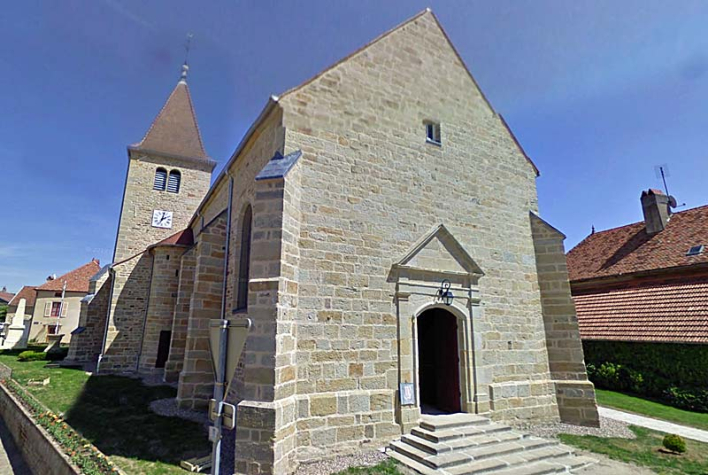
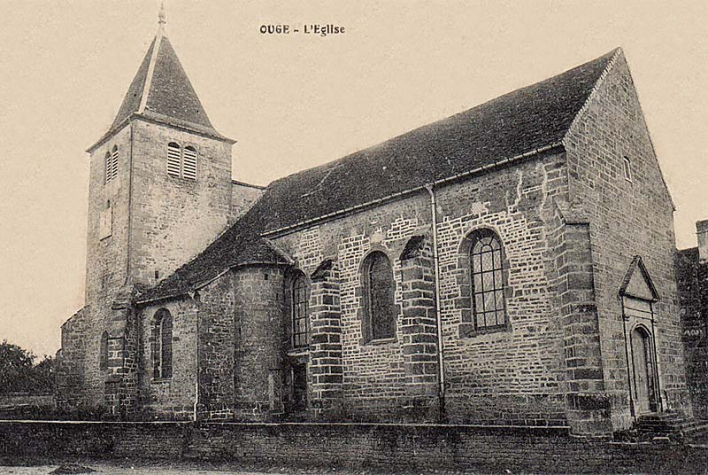
The oldest parts of the church date back to the 13th century. Like most of the houses in the village, it was burnt down in 1636, but the choir, one bay of the nave and three chapels escaped the flames. The bell tower staircase dates from the 16th century. The nave and chapel of the Immaculate Conception were inaugurated in 1750, several years after work had been completed. However, the stone vaults in three bays of the nave were too heavy and had to be replaced by wooden vaults in 1841.
Basket-handle exterior portal and Doric pilasters supporting a triangular pediment. Single nave of four bays with double barrel vaults on Doric pilasters. A beautiful 18th-century wrought-iron rood beam hangs in the middle of the nave. Two side chapels along the nave still have 18th century panelling; altarpiece with fluted pilasters; statue of the Immaculate Virgin from the same period. The chapel under the bell tower is vaulted with ogives on 13th or 14th century bases. Two bells. Altarpiece with two Corinthian columns surrounding an 18th-century painting of the Rosary, recently restored. Statue of Christ, popular art from the 17th century. In the right-hand chapel, vaulted on culottes, probably 13th century, painting of Notre Dame du Rosaire by the Langrois painter Jules Ziegler, 1848 (painting restored in 2023). Choir with one bay and flat blind chevet. Communion table in wrought iron from the 18th century. Elegant woodwork from the same period, recently gilded with fine gold. Altar-tomb and altarpiece in sculpted wood, continuing the panelling; in the centre, a large and beautiful painting by Claude-Louis-Alexandre Chazerand, a painter from Bisenne (1757-1795), depicting the Resurrection. On either side are statues of the Virgin Mary and St Rémi. The whole is vaulted with ogives on columns with sculpted capitals dating from the 13th century.
It is interesting to read the foundation plaque of the Rosary brotherhood by Jean Pernet and Françoise Villemot, dating from 1698. There is also a foundation stone by Philippe Maulpin, who died on 16 November 1621, "who annually and perpetually founded six pints of wine for Easter communions". Initially, this stone was above the sacristy door, which has since been moved. The 1698 foundation includes that of Philippe Maulpin, but specifies that the six pints of wine are intended for washing the altars...
To visit the church, send an email to the Town Hall. The interior is visible through the porch via a gate.
Eglise Saint-Rémy d'Ouge