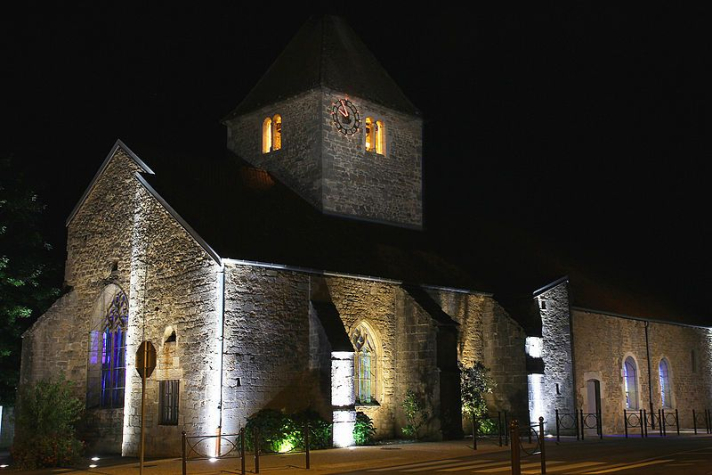
The church of Saint-Germain in Nogent-le-Bas dates back to the 12th century. It was part of a priory belonging to the Abbey of Saint Bénigne in Dijon. Its features give it a Romanesque style. The building is simple, consisting of a single nave. At the rear, the gable has a Gothic-style opening, topped by an occulus and high windows. These disparate openings show the many alterations this building has undergone over time.
On the load-bearing wall of the roof frame, we can see either small Romanesque-style windows, which are probably original, or larger windows that were opened after the building was completed.
At choir level, powerful buttresses support the walls, particularly at bell tower level. The square bell tower has a pyramid-shaped roof topped with a wrought-iron cross and a bronze weather vane in the shape of a cockerel. The bell tower is covered in flat tiles, while the nave is covered in fiddle tiles made in Rolampont.
The priory adjoining the church is still home to a cutlery factory, which was established here in 1854.
Inside Saint-Germain church
The main nave opens onto the aisles through semi-circular arches and large square pillars. This layout is very similar to that of the church at Vignory, a little further north in the département, built at the same time. A ceiling conceals the chestnut frame. It was installed to combat the cold.
As you enter the choir of the church, you can see the Gothic vaults, built after the church was built, resting on the Romanesque structure. The capital on the north aisle, level with the wall, is interesting. It features two small emaciated men against a background of branches and is quite similar to some of the capitals in the crypt of Saint-Bénigne in Dijon.
During the revolutionary period, in 1793, the Comité de Salut Public (Public Safety Committee), relying on the reputation of Nogent's products, sent citizen Pradier to Nogent to set up factories to make swords for the cavalry and bayonets for the infantry. Cutlers and chisellers were requisitioned for this purpose and the church of Saint-Germain was converted into a factory.
The furniture and stained glass windows of Saint-Germain church
Saint Germain church has some interesting furnishings. The oak pews are remarkably uniform. They bear the engraved names of well-known families of cutlers and chisellers. The statuary includes a 16th-century polychrome stone Christ-aux-Liens at the entrance to the choir and a beautiful 14th-century Pieta at the top of the altar in the south aisle.
At the far end of the church's chevet is a Eucharistic cupboard. It is particularly well preserved and dates from the Gothic period. The Blessed Sacrament was kept inside it, its presence indicated by a candle. A four-lobed occulus opens onto the outside. Its purpose was to remind worshippers passing outside of the presence of the Blessed Sacrament, encouraging them to meditate and pray.
The stained glass windows in the choir were made by a Dijon workshop and those in the occulus by a workshop in the Marne region. They predate the stained glass windows in the aisles. The latter are the work of Catherine Biquet, a master glassworker from Haute-Marne, who has restored a remarkable unity to the whole. She expresses faith as a quest for elevation, expressed in her stained glass windows by an upward movement, with supple, luminous forms.
Eglise Saint-Germain de Nogent-le-Bas