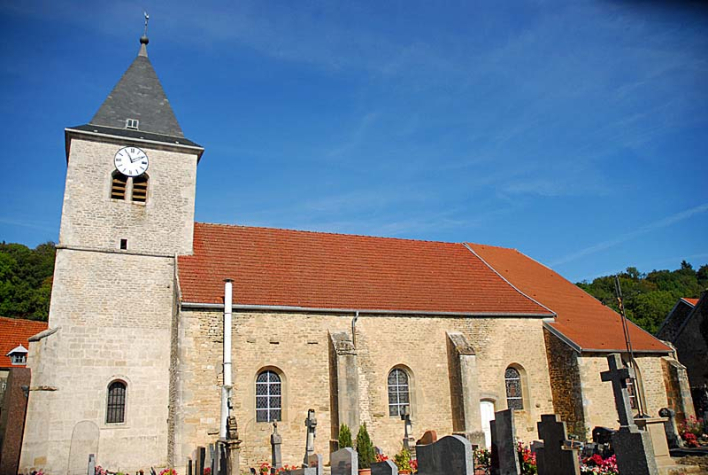
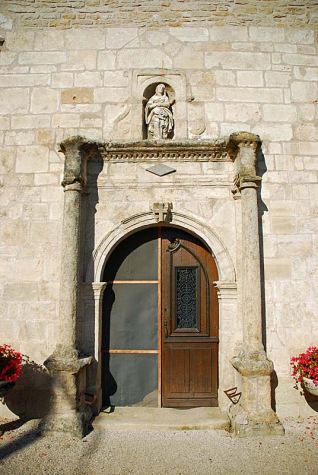
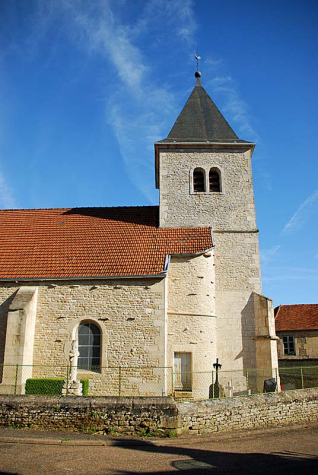
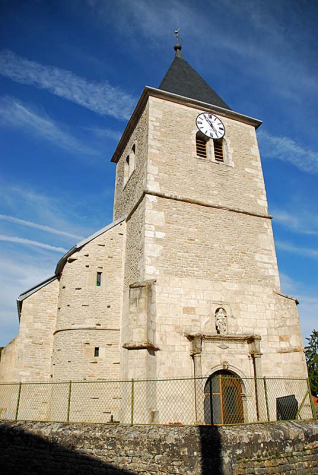
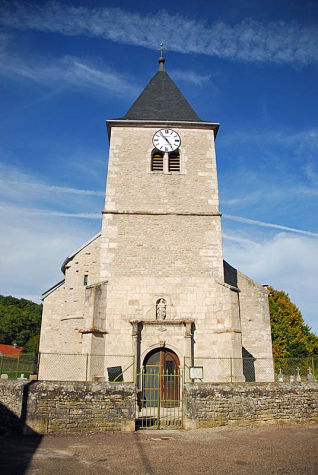
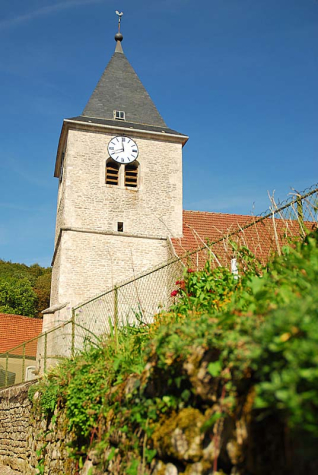
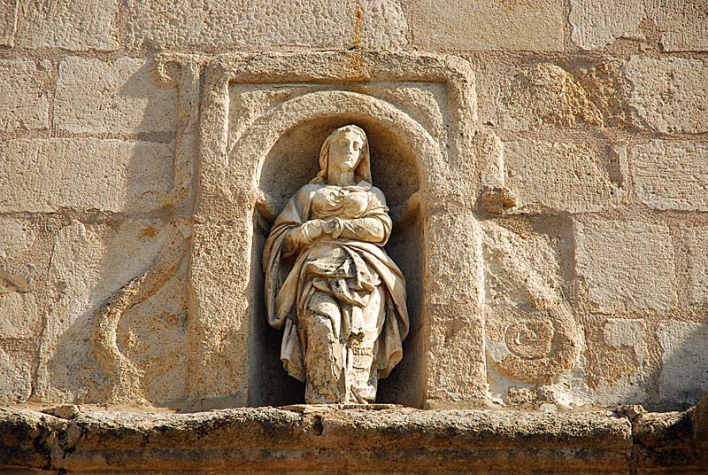
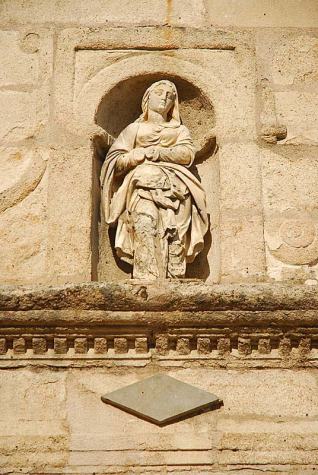
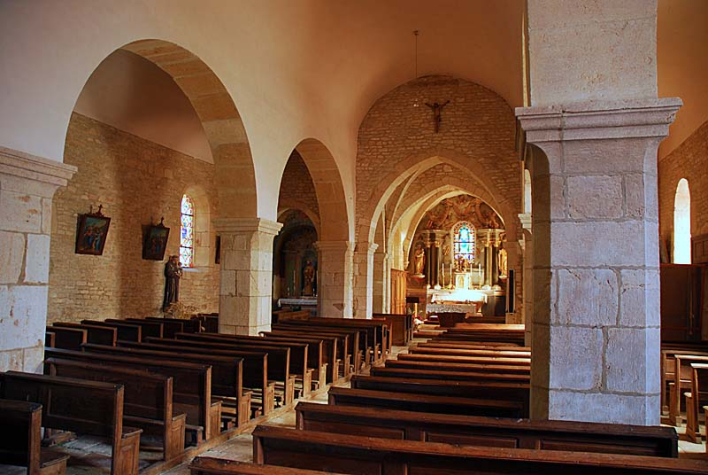
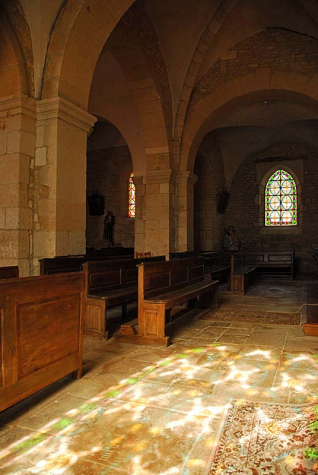
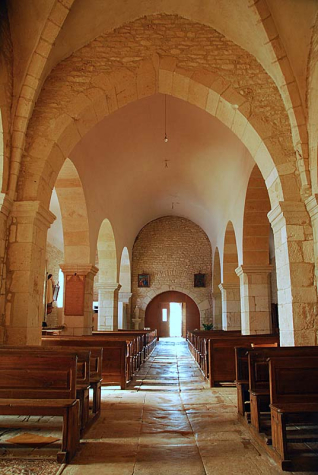
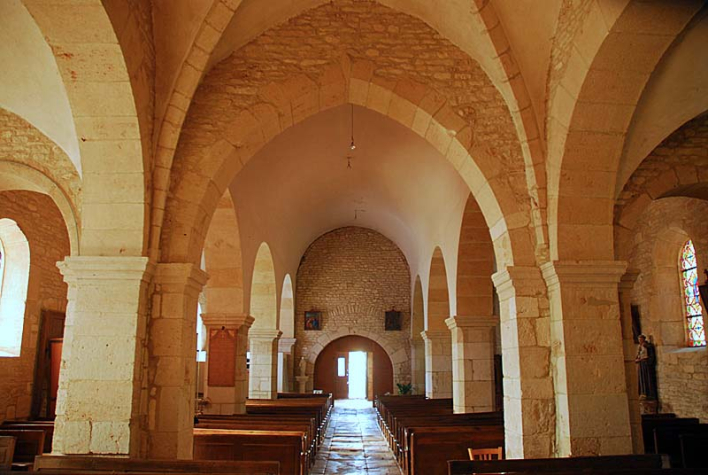
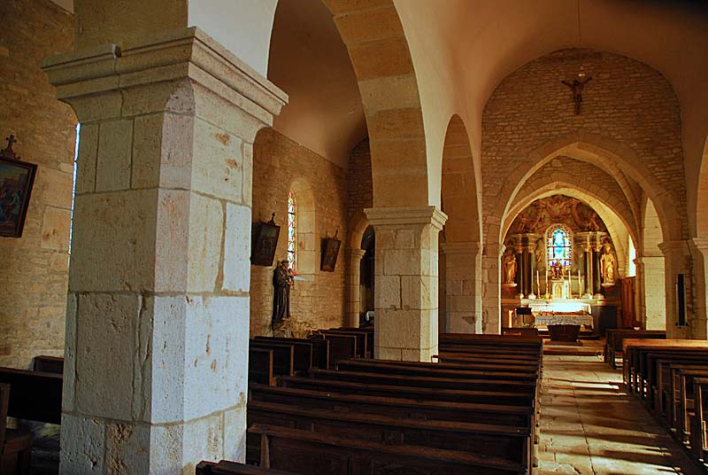
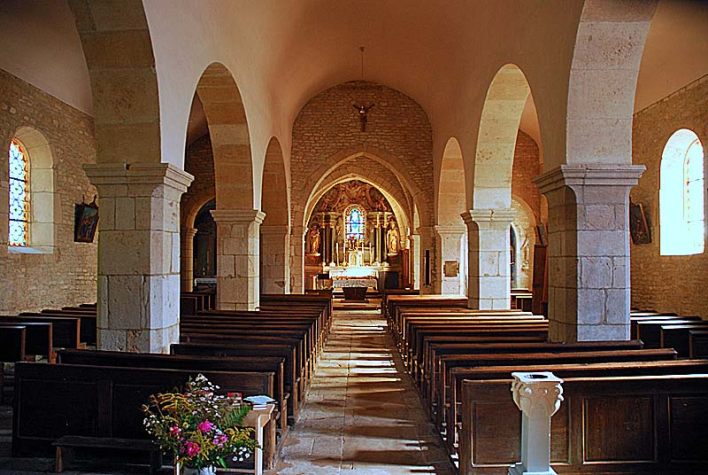
Little is known about the church of Cohons, which probably occupies the site of the site's former Merovingian oratory. All that remains of its reconstruction around the middle of the 12th century are the massive, chamfered square pillars of the nave, which until 1744 supported the double arches of a primitive barrel vault (which disappeared after this date), while the side aisles were planked. A trepan-worked capital visible in reuse in the Rue Candrée, most probably from the church, confirms this dating, which is supported by the presence of the first known parish priest, Guichard, as early as 1193.|Ravaged throughout the wars of the late Middle Ages, the choir was rebuilt in rubble stone most probably during the 15th century on ribbed crossbeams, with the whole of the transept with its slightly projecting arms, and the portal in the following century.|But the portal was again rebuilt in the 17th century as a tower-porch (probably after the events of 1643), as attested by its classical style, with a semicircular door surmounted by an engaged entablature supported by two Tuscan columns on dices, surmounted by a Virgin in a moulded niche framed by two esses, brought back by the parish priest Anatole Barrillot (1813-1817) after the Revolution. To the left of the doorway, access to the attic and the bells is via an external turret that has been preserved without its original roof, housing a 16th-century spiral staircase, which may have adjoined a doorway from the same period, from which the lintels seen above probably originate.| In the 18th century, the entire church underwent major works, under the impetus of Claude Forgeot, an architect from Lange, in the service of the canons. In 1744, the pillars, vaulting and roof structure were removed from the lava-covered nave. The pillars were then reassembled and the vaulting replaced by a new one made of local tufa with a semicircular arch, but without the double arches; Two years later, the walls of the choir and its external buttresses, made of small rubble stones, were entirely rebuilt in ashlar, the vault only being consolidated and re-blanched. Finally, in 1748, the entire forechoir and triumphal arch were rebuilt right up to the entrance to the side chapels, the vaulting was made of tufa and the whole structure was whitewashed. In the choir with its flat chevet, the main altar in stucco with a limestone altar table is surmounted by a tabernacle and a wooden display made up of two cherub statuettes, a glory and a crown forming a canopy. The whole is framed and surmounted by a monumental stucco altarpiece with colonnettes framing the axial window, crowned by a glory against a background of clouds dotted with winged cherubs' heads. The 18th-century altarpiece came from a workshop in Langon and has been listed since 1918.|Among the furnishings, on either side of the main altar are an 18th-century polychrome wooden Virgin and Child and a Saint Didier without attributes, both listed in 1918; On a pillar to the right in the nave, you can still see a copper plaque (49 x 36 cm) made in March 1748 by Jean (Baptiste) Gillot, Master Foundryman in Langres, commemorating the foundation made by Jean Drevon, merchant-librarian in Langres and Anne Diderot, his wife, of the exposition and blessing of the Blessed Sacrament on the parish feast day of Cohons.|The church of Cohons, served by the monks of the Chapter of Langres, who alone collected the tithe, saw a succession of prestigious canons serve the parish: These included Guichard, dean of Môge and the first known parish priest of Cohons (in 1193); Christophe Roussat (1555-1575), uncle of Jehan Roussat, mayor of Langres; Jean Thabourot, archdeacon of Barrois and author of the Orchesographie (in 1595); and Anatole Barillot, professor and later director of the major seminary in Langres (1813-1817). Until the 19th century, Cohons was annexed to Percey-le-Pautel, which came to bury its dead in the cemetery via the "Chemin des morts" linking the two communes.
Eglise Notre-Dame-de-la-Nativité de Cohons