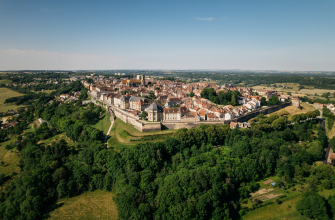
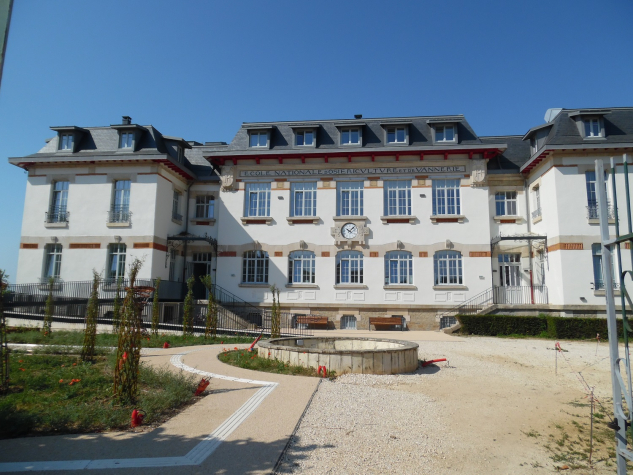
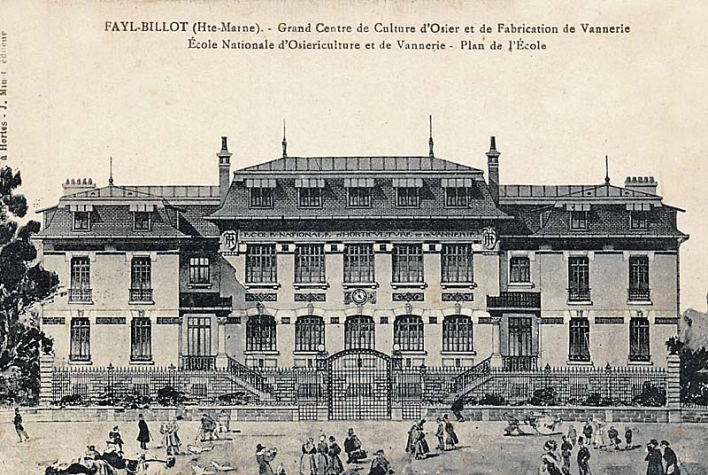
A landmark in Fayl-Billot, ENOV's original building was constructed on the ruins of a medieval castle; indeed, the two streets that run around its flanks are called "Rue du château" and "Ruelle du château" respectively. The central part of the building, in pure 1900 style, was built between 1908 and 1909. The east wing was added in 1912 and the west wing in 1927. When it was built, the school was known simply as the "Ecole Professionnelle de Vannerie". In 1907, for financial reasons, the Fayl-Billot town council bequeathed the running of the school, as well as the buildings and land, to the Ministry of Agriculture, which renamed the building - and the training body - the "School of Horticulture and Basketry". At the time, the aim was to train rural craftsmen capable of running a small family farm, alongside growing and working wicker. In 1912, the school took on its definitive name, the "Ecole Nationale d'Osiériculture et de Vannerie". It was at this time that the first basketry diploma was awarded.
In 1969, the school's title and name were officially withdrawn. It then became the "Collège Agricole Masculin" and, in 1979, was annexed to the Lycée Professionnel Agricole de Fayl-Billot.
In 1986, ENOV became the Centre de Formation Professionnelle et de Promotion Agricoles (C.F.P.P.A), the name it still bears today.
Only two schools remain in Europe, the second in Germany at Lichtenfelds. The third, at Nowy Tomysl in Poland, closed its doors in 2009.
Ecole Nationale d'Osiériculture et de Vannerie, coté patrimoine