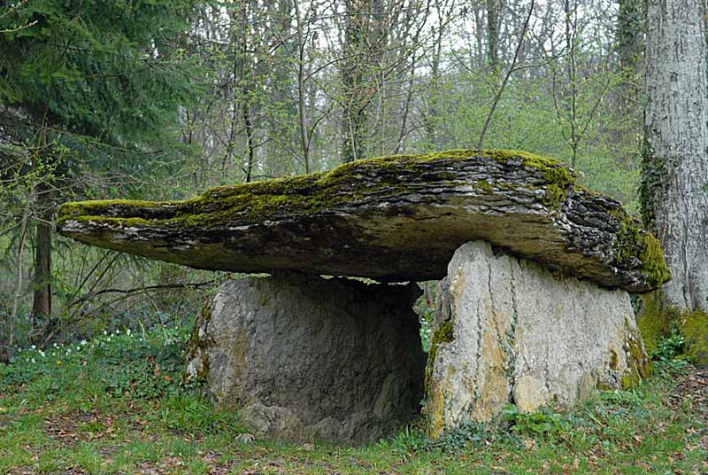
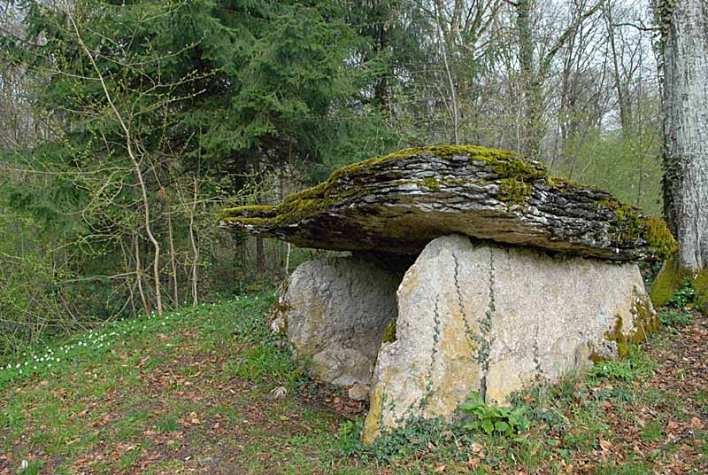
Located less than 5 km south of Nogent, this megalith was listed as a Historic Monument in 1887 and is a local curiosity. The covering slab weighs around 9 tonnes and measures 3.20 m wide (south side) and 2.50 m long. It rests on two parallel orthostats that open up the chamber to the south over a length of 2 m. To the north, the bedside slab closes off its end. The height of the chamber, which is higher at the entrance than at the bedside, is around 1.20 m. A paving slab is still visible under the earth filling this chamber.
Built between the end of the 5th and 3rd millennia BC, dolmens often take the form of simple stone tables (dol = table and men = stone), which for a long time suggested that they were pagan altars used for sacrifices.
However, we now know that dolmens are only the least eroded part of a complete burial complex, which originally also included an access corridor (often made of dry stone) and a tumulus (an artificial mound of earth under which the bodies of the deceased were stored).
Some of these features can still be seen near the Pierre Alot, surrounded by cruciform burial mounds.
The "Pierres à l'eau" (water stones) have an excavation on their horizontal face, but it is not clear whether this is natural or man-made.
Tradition has it that an illustrious warrior was buried here.
Dolmen "La Pierre Alot"