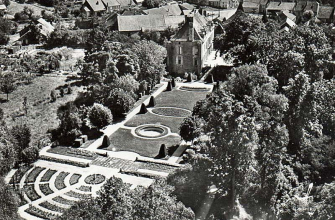
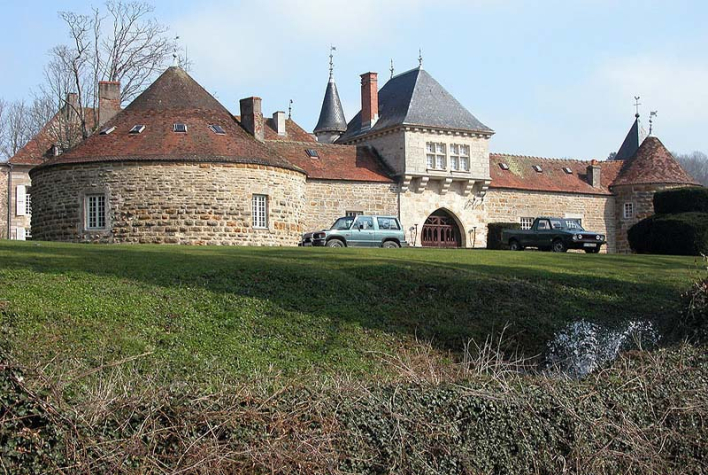
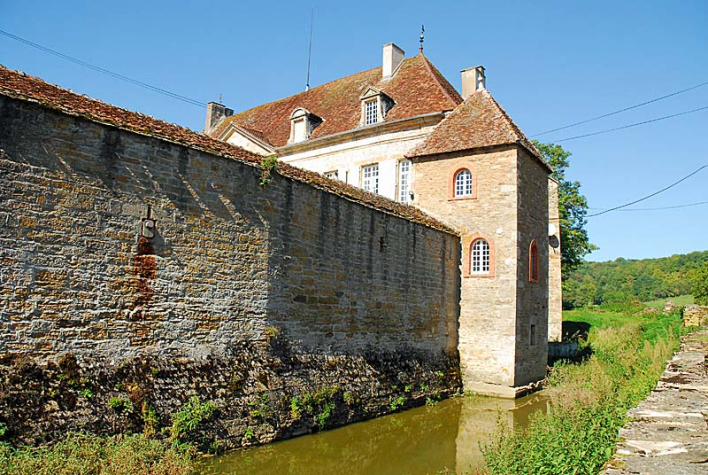
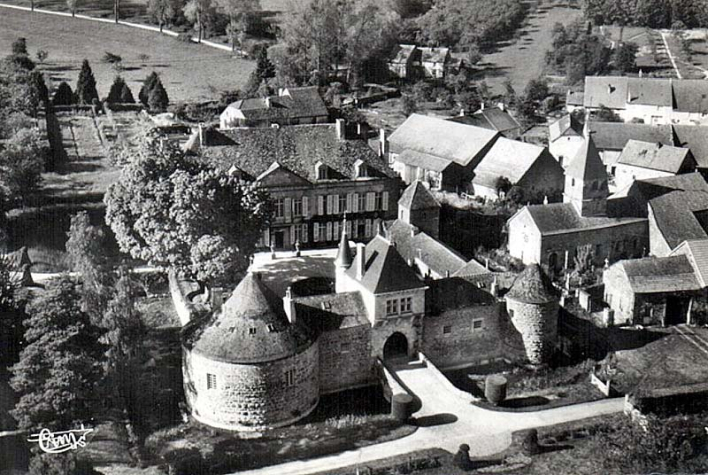
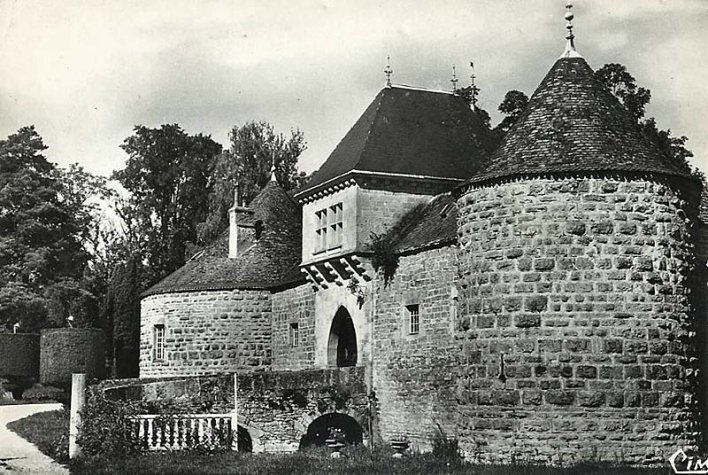
The château is a handsome building, with a beautifully composed entrance portal dating from the Louis XIV period. Between two pedestrian gates, the carriage gate is topped by an entablature and framed by straight legs adorned with pilasters bearing fire pots. In the Middle Ages, the castle was set in a quadrilateral, the plan of which is delimited by a wide moat. Passing over a stone bridge spanning the moat, you can now access the cross of honour via a gateway with medieval pretensions (false machicolation). It was built at the end of the 19th century, in the middle of the old wall topped by two squat, round towers that have retained their defensive features (loopholes).
At the far end of the courtyard of honour, a main building constructed in the early 18th century features "a harmonious facade of pleasing proportions, marked on two storeys by a good balance between full and empty spaces".
To the south, a footbridge gives access to the parklands designed by Le Nôtre, the creator of the gardens at Versailles. The facades and roofs of the entire château, moat, bridges, wrought-iron gate to the west ditch, entrance portal and grand staircase with its wrought-iron banister have been listed on the Inventaire Supplémentaire des Monuments Historiques since 12 January 1987. In the 16th century, it was the property of Gaspard de Saulx-Tavannes, Marshal of France.
A rich past:
In 1211, mention is made for the first time of a lord, Hugues de PRANGEY (Prangeium), who had two sons: Eudes and Milan. Both of them donated part of their property.
In 1275, Guillaume, probably Milan's son, sold the woodland of the boverie to the monks of Auberive for 250 pounds and .... a cow.
In 1315, Guy, Lord of Prangey, received a donation from the Duke of Burgundy. This is the last known name! In 1350, the castle belonged to the BAUDRICOURT family (or BAUDONCOURT, according to some) and the tomb of a knight of this name can still be seen in the church.
On 22 April 1422, Prangey passed to the de SAULX family through the marriage of Guillaume de SAULX to Guillaumette de BAUDRICOURT (contract signed at the château).
In the 16th century, Théodore de SAULX, great-grandson of Guillaume, sold the Prangey estate. After belonging for some time to magistrates from Dijon, the château was bought in 1566 by Marshal Gaspard de SAULX-TAVANNES, owner of Château du Pailly. It remained the property of this family until 1695.
In the 18th century, the château and the seigneury of Prangey and Vesvres were bought by the PIETREQUIN family of Langres for 45,000 francs.
On 29 June 1701, a transaction and acknowledgement was signed between Messire Philibert Pietrequin de la Borde and the inhabitants of Prangey represented by their attorney Sindic François MOISSON". It is stated, among other things, "that the inhabitants are subject to the maintenance of the dormant bridge over the castle moat, on condition that the said lord gives them retreat and asylum in times of war, as well as their furniture".
The last lord of Prangey was Claude Henri Bernard PIETREQUIN, known as the Chevalier de Prangey. He emigrated in 1791, returned to France in 1803 and sold the château in 1812.
In the mid-19th century, the château was owned by GIRAULT de PRANGEY, a distinguished artist who, at the time, built an "oriental" town with lush gardens in Courcelles-Val-d'Esnoms, which has now been destroyed.
After the Second World War, and until 1975, the château was transformed into a "Hostellerie".
After belonging for several years to Mrs and Mr Paul LASSUS, it was bought in 1992 by a Danish couple, Thorkild and Grethe KRISTENSEN. Distinguished guests often pass through here.
No visits: private site only visible from the outside.
Château XIXe siècle de Prangey