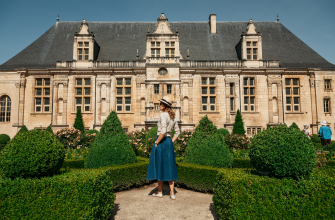
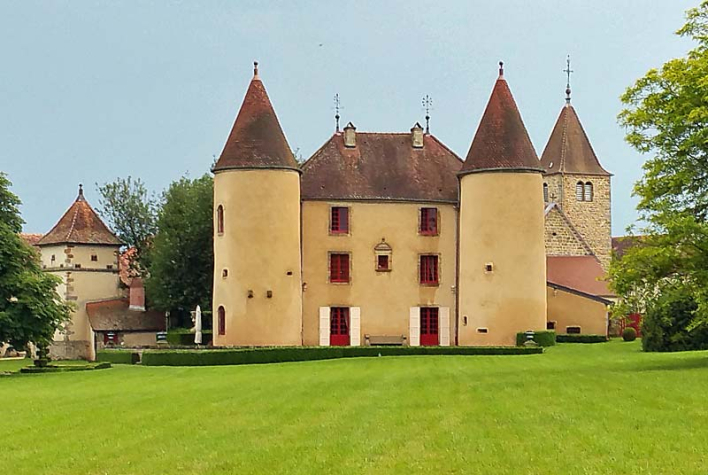
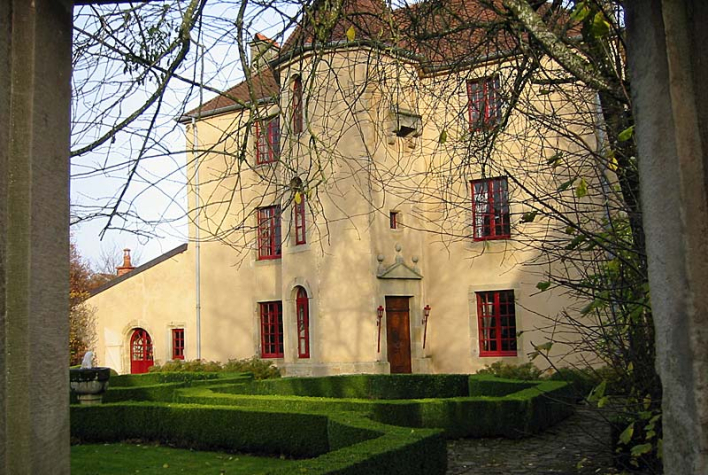
Château d'Ouge is a fortified manor house with three storeys. It is flanked to the east by two round towers, slightly higher than the dwelling, and to the west, overlooking the courtyard, by an octagonal tower containing a fine spiral staircase. The three towers are pierced by gun ports and the entrance door is topped by a small artillery post from which missiles could be fired at potential attackers. The vaulted cellar, half-buried, is built on the north side. The volumes are those of the original construction. However, most of the openings (windows, entrance door) were created or enlarged in the 1840s. The outbuildings, known as the "lodgings", were rebuilt in the 1850s along the same lines as the original buildings, but set back some fifteen metres.
Château d'Ouge was built in 1553 by Jehan de Thon, a squire, probably on the site of an earlier manor house. He belonged to a very old chivalrous family from the Barrois mouvant (modern-day Vosges). But he was a small lord, ruling over around twenty fires (households), or just one sixth of the village's inhabitants. He exercised middle and lower justice (offences punishable by the carcan or fines), the upper justice being held by the lords of Chauvirey. At the end of the 17th century, the last descendant of the de Thon family being a priest, the château and lordship of Ouge passed on his death to Charles de Champagne, his mother's great-nephew, who sold them in 1697. In 1699, the new owner, Jean-Etienne de Montessus, who had been living in the Château de Vitrey, moved to Ouge with his family. In 1705, having become Lord of Aigrevaux, near Vesoul, he leased the Château d'Ouge to François-Salomon Régent. The latter, the son of a notary from Chauvirey-le-Châtel, had bought a small portion of the barony of Chauvirey in 1687 with special permission from Louis XIV, as he was not a noble. He died in Ouge in 1723. His daughter Catherine-Françoise married a dragoon officer there a year later, François-Vincent Faivre, ancestor of the du Bouvot family. From 1729 onwards, Château d'Ouge was inhabited only by the "amodiateurs" (receivers of seigniorial revenues), with the noble owners only making short stays or passing through. After the death of Count Antoine-François de Montessus (grandson of Jean-Etienne) in 1793, Château d'Ouge was abandoned. The heirs of the Countess de Montessus sold it in 1833, along with all the other properties left by her husband, to Charles-Auguste Leroi de Lisa (mayor of Vesoul from 1830 to 1833), who, ruined, sold it in 1838 to a farming couple from Ouge. Heavily in debt himself, the latter, after largely restoring the château, sold it in 1849 to a Parisian velvet merchant, Pierre-Nicolas Dupuis, and his wife Thérèse-Angélique Paulmard, a local girl with a tumultuous life.
The château remained in the Paulmard family for five generations, until 1980. For mysterious reasons, it escaped being burnt down in 1636. It was occupied by coalition troops in 1814 and again in 1815, by the Prussians in 1870 and by German officers in 1940-41.
Château d'Ouge has been listed as a historic monument since 1989.
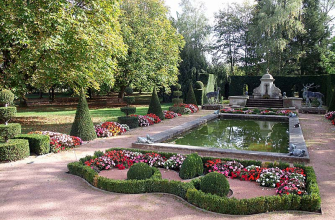
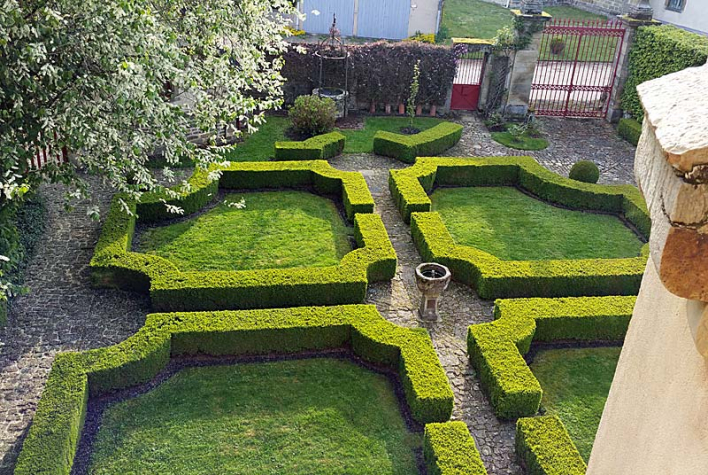
The property is privately owned. You can visit the gardens and park around the château.
Private site: view of the exterior of the property.
Guided tours of the park and gardens are available by appointment only.
Château d'Ouge