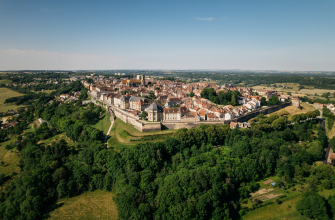
Among the many castles that covered south-eastern Champagne in the Middle Ages, Vignory castle is one of the few to have survived the centuries to the present day. Vassals of the Counts of Burgundy and then of the Counts of Champagne, the Lords of Vignory extended their Barony and then their County over the 26 surrounding communes.The first written trace of the castle dates back to 1050-1052. It was originally a "castrum" held by the 1st Lord of Vignory.
Gui I (1011-1040) was the first known lord and founder of the church of Saint-Étienne and its priory. Under the reign of his son Roger I, the first written mention of the castle appeared: in a charter dated 25 May 1050-1052, to earn remission for his sins, Roger donated the newly-built church as well as "what belongs to me, namely the chapel of my castel" to Saint-Bénigne in Dijon.
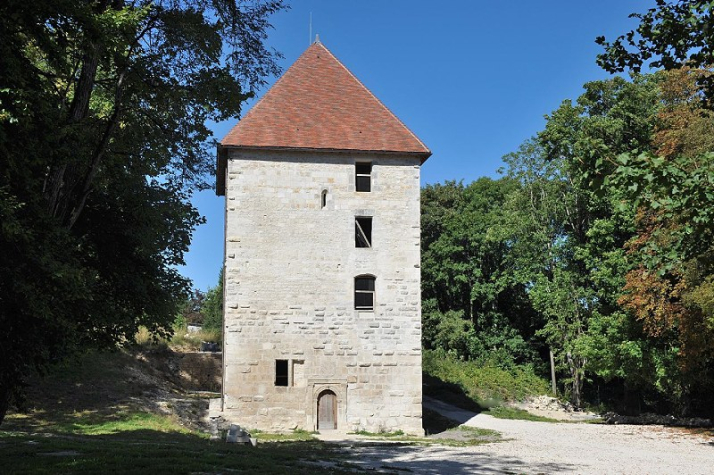
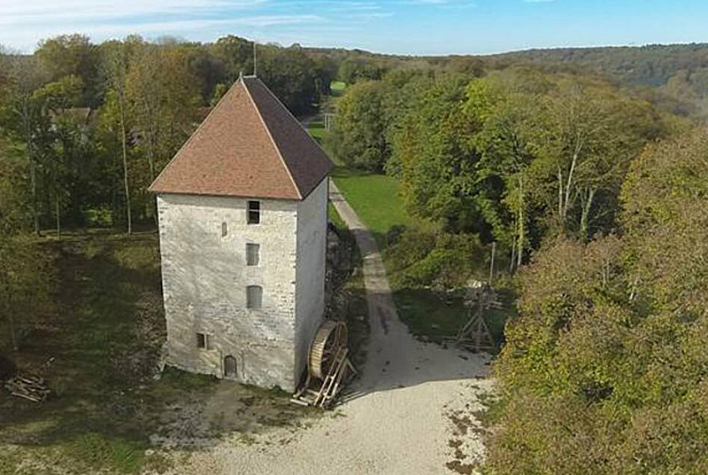
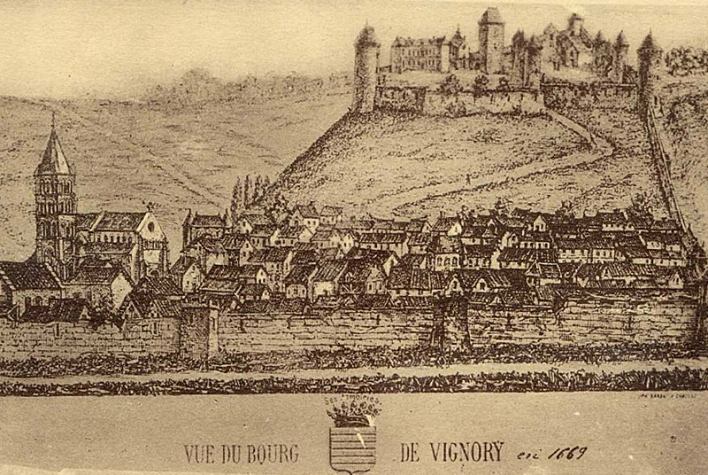
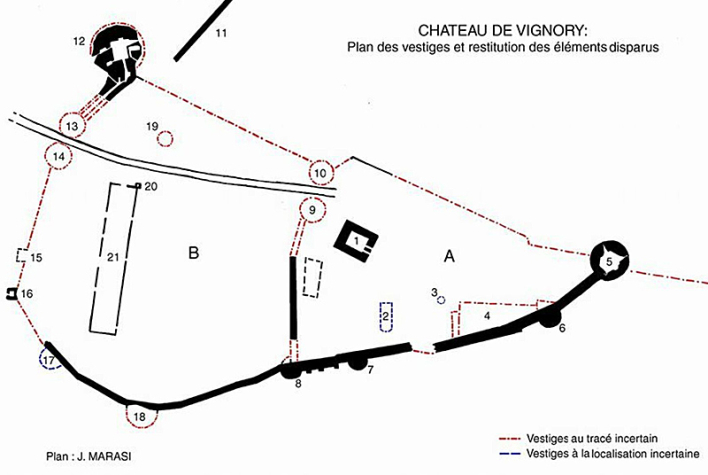
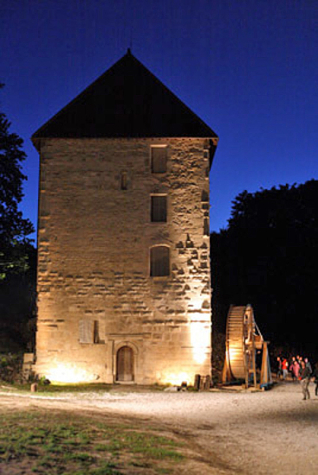
The castle's development and fortification campaigns followed in quick succession. In the middle of the 12th century, the keep known as the Tour Quarrée was built on the upper courtyard. In 1204, Gauthier I, knight banneret under Philippe Auguste, had the town of "Vangnorry" enclosed by walls and towers that joined the castle ramparts.
After two sieges at the end of the 14th century, the castle fell into disrepair.
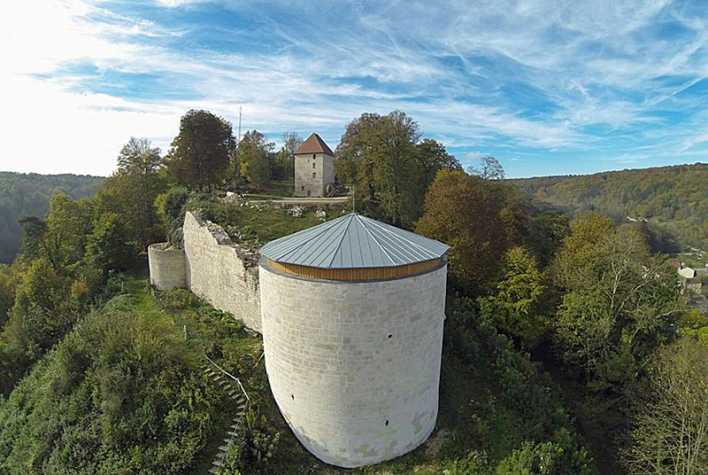
In 1416, Jean de Vergy initiated major restoration work, including the construction of the Tour au Puits (Well Tower) at the tip of the rocky spur. A seigneurial dwelling, brighter and more comfortable than the old keep, was built in the main courtyard of the Haute-Cour. Around 1490-1495, Jean de Baudricourt had the enormous gun tower built at the corner of the Lower Courtyard, where the village rampart was joined. With its 20-metre diameter, 7-metre thick walls and gunports, it was the castle's defensive lock.
An entrance gateway, with a portcullis and drawbridge over a dry moat, defended the entrance to the lower courtyard, which included a farm, houses, a large cistern and a dovecote with up to 1,200 bolt holes.
A 1773 inventory shows a lower courtyard surrounded by ramparts flanked by 7 enormous towers, housing the farm, stables, barn, dovecote and gardens, and an upper courtyard flanked by 3 towers and including the keep, the Puits tower, a chapel, a manor house, a cistern and outbuildings. This part was reserved exclusively for the lord, his family and his retinue.
Today, many remains remain, including the 12th-century keep, the 15th-century Tour au Puits and the south curtain walls, which are listed historic monuments.
Consolidation work on the ramparts has been underway since 2003. Between 2009 and 2015, major restoration and consolidation work was carried out, enabling visitors to tour the keep and the Tour au Puits.
Château de Vignory