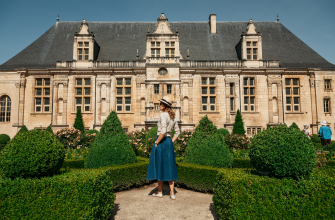
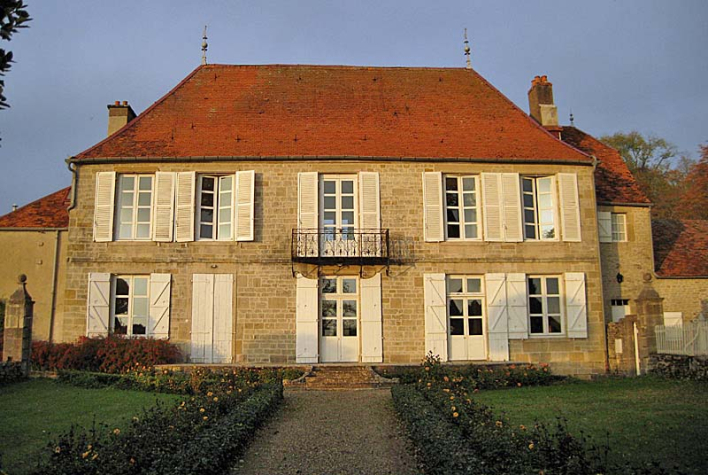
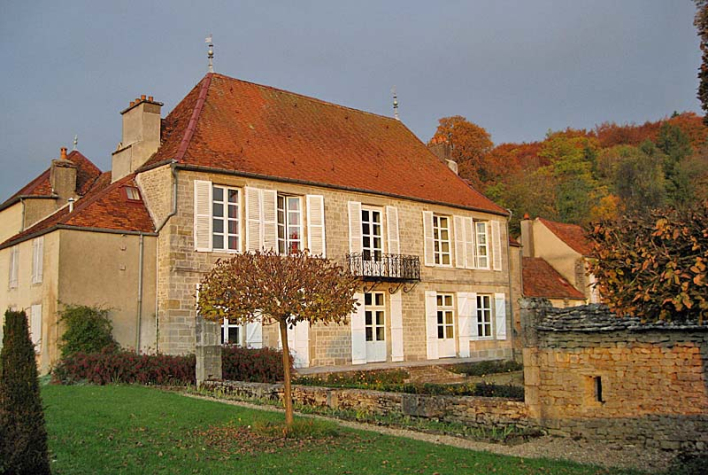
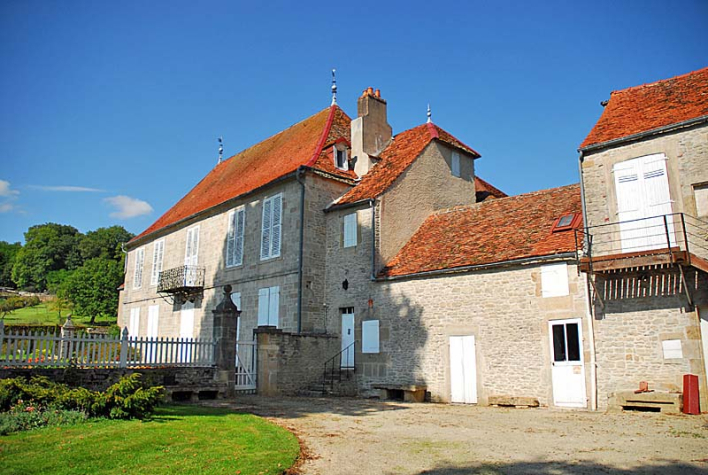
This pleasant, one-room, high-walled estate of three hectares is located in a place called Silière (from the Latin Salinaria = marshy place; "en Salières" in 1247). It was built in 1659 for Nicolas Méat, a councillor at the Bailliage and Presidial Court of Langres.
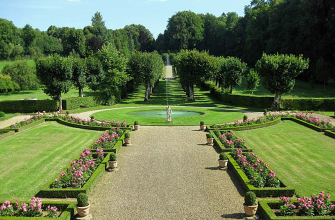
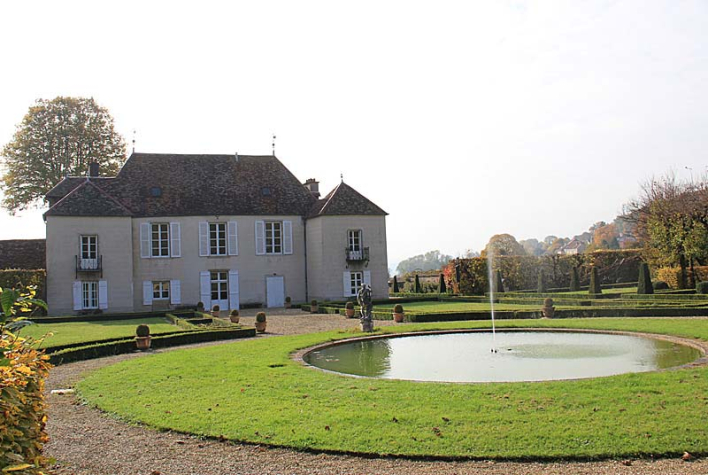
The château has a garden facade with two pavilions overlooking a vast formal garden (known as "à la française") that slopes up the hillside. The garden was described in 1684 as "adorned with fountains, espaliers and trellises; to the right is the menagerie, to the left an orchard, with the pavilion at the far end; the layout is so beautiful that opening the door reveals the full depth of this beautiful residence and an infinite number of waters gushing from the water table into the courtyard in different ways, where art, combined with nature, finds something to satisfy the curiosity .... the garden has different beauties: some are natural, others artificial. The canal that runs the length of the middle alley, interspersed with waterfalls, is of such pleasant variety that one cannot leave it to visit the other beauties of the alleyways, grottoes, cabinets, flowerbeds and other canals of such lively water that one can see all the way to the bottom".
After belonging to the Méat family for a long time, the château was owned by other Langre families: Le Picard, Raphaël Gaucher, who called himself "Gaucher de Sillières" around 1740, Guillaume Gousselin in 1757 and M. Donzé in 1783. In 1812, it was bought at auction by François Bertrand (brother of Langres sculptor Antoine-Henri Bertrand), who passed it on to his daughter Zilia, who married Pierre Jacquinot, a lawyer in Langres, and then to Marie Jacquinot, his granddaughter, who married Nicolas-Augustin Massin de Pressigny, an imperial prosecutor. The estate then passed successively to Etienne Massin, Jacques Massin and finally Pierre and Christiane Massin, who have looked after it with passion since 1972, before passing it on to their daughter, Isabelle Sauvegrain, in 2012.
The ensemble is most remarkable for its French-style garden, laid out at the end of the 17th century and said by family tradition to have been designed by Le Nôtre or one of his pupils.
The garden suffered greatly during both the Revolution and the Second World War, after which the statues had to be replaced and hornbeams replanted. Pierre Massin, who has tended this centuries-old garden, which came into his family in 1812, with great passion and pleasure, saw the ornamentation of the Greek mythological statuary as "an accompaniment to a highly symbolic path of light" in a gradual ascent towards the statue of the Sun King enthroned at the very top of the main avenue.
Château de Silière et son jardin